Beginner English Listening Resources: Short Audio You Can Check With a Transcript

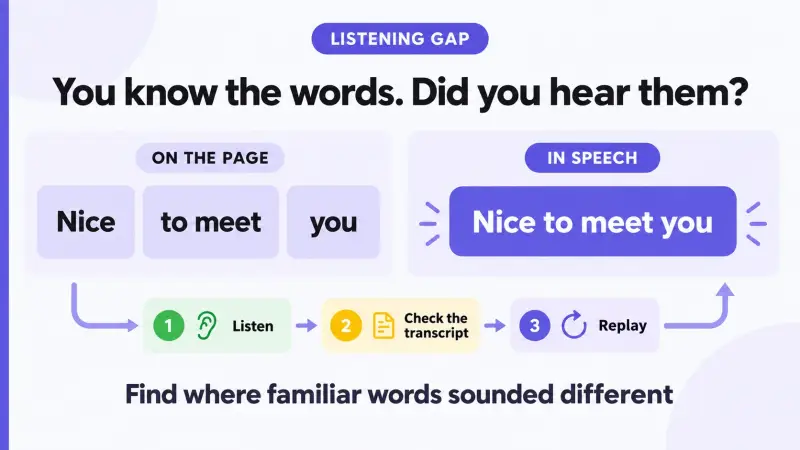
You can read "Nice to meet you" without slowing down. Then someone says it to you at normal speed, it lands as one short blurred sound, and you answer half a beat late. The words were not new. The shape they arrived in was.
For that gap, start with audio short enough to replay and a written version sitting next to it, so you can see which familiar word sounded unfamiliar. Three publishers put exactly that in front of beginners: British Council LearnEnglish has a graded A1 listening section, VOA Learning English runs the Let's Learn English beginner course, and the ELLLO team publishes Sound Grammar lessons built around a single pattern.
Quick Picks: British Council LearnEnglish, VOA, ELLLO, and HelloTalk
These four are not interchangeable, and they do not compete for the same slot in your week. Each one answers a different version of "I read it fine, I cannot hear it," so the useful question is which version is yours right now. If you are still deciding what to install in the first place, the wider roundup of the best English learning apps for beginners handles that choice. This page stays on short audio and the text support that comes with it.
Read the table from the last column backwards. Find the difficulty that matches what happened to you this week, then open the sample lesson named in that row instead of browsing a whole site.
| Resource and sample lesson | Level shown on the page | Audio or video | Text support | Built-in practice | Difficulty it suits |
|---|---|---|---|---|---|
| British Council LearnEnglish, A1 listening lesson "Booking a table" | Marked A1 | Short audio recording | Full transcript on the same page | Preparation exercise, Task 1, Task 2 | You know the words on paper but lose them inside a normal exchange |
| VOA Learning English, Let's Learn English Lesson 1 "Welcome" | Beginner course lesson | Audio with teaching media | Written conversation published with the lesson | Teaching media that walks through the conversation | You want one complete beginner lesson with the script beside you |
| ELLLO Sound Grammar, the lesson on "can" for abilities | False Beginner / A1 | Four short conversation recordings | Script section for the lesson | Grammar note and quiz | You know a pattern but miss it inside different exchanges |
| HelloTalk | Not graded, because a real person picks the words | Voice messages, voice calls and video calls | You can ask your partner to type the sentence you missed | No set task, you choose the topic | You follow a rehearsed recording but freeze when someone answers you |
Each of these three publishers pairs short beginner audio with a written version on the same page, which is what lets you locate the exact word that sounded different from the way you read it. The fourth row belongs in the same table because a script can only show you what a recording already said, and at some point you need a voice that answers you.
British Council A1 Listening: Start With a Familiar Everyday Situation
Start here if you want tight structure and almost no setup. The A1 listening section on British Council LearnEnglish is graded on the page itself, so you are not guessing whether a recording sits above your level before you press play.
The British Council LearnEnglish A1 lesson "Booking a table" is marked A1 and puts a preparation exercise, one short recording, a full transcript and two comprehension tasks on a single page. The situation is deliberately ordinary: reserving a table, then changing the number of people and the time. Because you already know what the conversation is about, your attention goes to the sound rather than to working out the topic.
Here is one way to run it, offered as suggested practice. Do the preparation exercise first, since it puts the key words in your head before any audio starts. Play the recording once with the transcript closed and write down only the chunks you actually caught, even if that is three words. Then open the transcript and mark every place where what you heard and what is written do not line up.
Those marks are the real result of the session. They are rarely words you never learned. They are words you know that arrived shorter, joined to the next word, or without the stress you expected. Task 1 and Task 2 check whether you understood, so a full score tells you the meaning got through, not that you could produce the same lines yourself. What a page offers for saving or offline playback varies by browser and player, so check that on your own device before you plan a commute around it.
VOA Let's Learn English: Follow a Beginner Lesson With a Written Script
The British Council page gives you one situation at a time. Some weeks the opposite is more useful: a single lesson that runs from start to finish and brings its language back in different positions, so a phrase you met in line two turns up again in line nine.
VOA Learning English's Let's Learn English Lesson 1, "Welcome", is a beginner course lesson published with a written conversation and teaching media, while the wider VOA Learning English catalogue also carries programmes written for higher levels. That distinction is worth holding onto while you browse. A news programme published for advanced listeners can feel impossible straight after a beginner lesson, and the difficulty belongs to the material, not to you. Choose by the course name rather than by the site name.
Lesson 1 is a greeting and introduction lesson, which is exactly the situation described at the top of this article. Work through the conversation once with the script in view, then replay it with the script covered and say the second speaker's lines out loud slightly before the recording does. Speaking early forces you to predict the rhythm instead of recognising it after the fact.
If your practice window is ten minutes on a bus rather than half an hour at a desk, the guide to English learning apps for quick daily practice covers tools built for that length of session.
ELLLO Sound Grammar: Compare Short Conversations Using the Same Pattern
The two pages above each hand you one recording for one situation. The ELLLO team's Sound Grammar lessons come at listening from a different angle: one grammar point, several short conversations, so you meet the same structure in more than one exchange during a single sitting.
The ELLLO Sound Grammar lesson on "can" for abilities carries a False Beginner / A1 label and builds four short conversations around one grammar point, with Script, Grammar and Quiz sections on the page. The four conversations share the same speakers, so what changes between them is the wording and the context around the pattern, not the accent. That is a narrow kind of variation, and for this particular job it is the useful kind.
Use the lesson as a comparison exercise rather than a test. Listen to the first conversation with the script hidden and note how the pattern sounded inside it, then do the same for the other three before you open anything. When you finally read the scripts, ask one narrow question: did the target words carry stress, or did they get swallowed between the words around them? A form you learned in its slow, isolated shape can slide past unrecognised in its fast, reduced shape.
This is why "I know this grammar" and "I can hear this grammar" are separate achievements, and why listening can trail reading for a while. The skill-by-skill view of building English fluency goes into how the four skills tend to move at different speeds. Passing the quiz on the "can" lesson tells you the pattern is familiar in those four recordings. The False Beginner / A1 label describes the material, not you.
When Should You Read the Transcript, and When Should You Hide It?
A reasonable default for a short clip: hide the text for the first play, open it once to check, then hide it again. If a blind first listen gives you almost nothing, that is not a reason to abandon the recording. Glance at a few key words or the opening line, cover the text again, and replay. A little context before the first pass is an adjustment, not a failure.
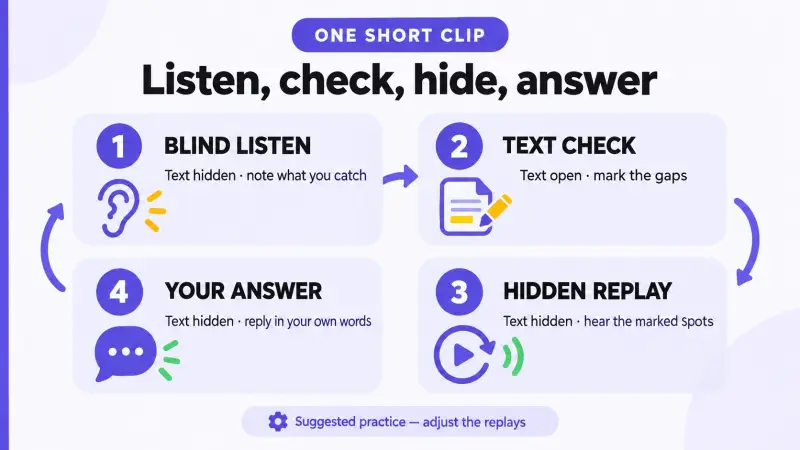
To keep this concrete, the table below breaks one recording into four passes: a blind listen, a text check, a hidden replay, and your own answer. They are a sequence rather than a ranking, and all four fit around a single clip of a minute or two. The last column matters most, because what you write down is what carries over to the next session.
| Pass | Transcript | What you do | What you keep |
|---|---|---|---|
| 1. Blind listen | Hidden | Play once at normal speed without pausing | The chunks you caught, written in your own spelling |
| 2. Text check | Open | Read along while it plays and mark every gap between what you heard and what is written | The two or three spots where the sound surprised you |
| 3. Hidden replay | Hidden | Replay until the marked spots arrive on time instead of a beat late | Any line that still blurs after several plays |
| 4. Your answer | Hidden | Say or record a short reply to the situation in your own words | One thing you could not say, saved for a real conversation |
This is suggested practice, and the number of replays is yours to set. Pass 4 is what turns a finished lesson into something usable: the booking recording starts paying off when you can produce your own version of "a table for three at eight, please" without hunting for the words.
One limit is built into the cycle. A recorded lesson plays the same wording every time you press play, while a person answering your message chooses their own wording on the spot. The four passes above add repeated listening to one short clip. The section below adds the other half: a speaker who responds to what you actually said.
HelloTalk: Practise Understanding and Answering a New Voice
This is where the lesson stops being a closed loop. The point is not to drop graded audio, it is to take the same everyday topic to someone who never read your transcript.
HelloTalk carries text and voice messages plus voice and video calls inside the same chat, and HelloTalk also hosts Moments, where members post short public updates. For this particular problem, voice messages are a practical starting point, because you can record when you are ready and replay what comes back as many times as you want.
A full round, as suggested practice, looks like this. Take the situation from the lesson you just finished, for example the restaurant booking from the British Council A1 page, and send a short, simple voice message that invites a short answer back:
"Hi Emma, today I studied a lesson about booking a table at a restaurant. Do you eat at restaurants often?"
Keep it that basic. A two-sentence message is easier to record, and a small question is easier for someone to answer in a way you can follow.
Then work with whatever reply arrives. Replay it twice before you do anything else, since an unrehearsed voice gives you no preparation exercise and no predictable script. It may contain something your lesson did not include: a contraction, a filler word, a place name. If one part still will not resolve after two plays, ask the person to type just that sentence in the chat and compare the written line with what you heard. It is the same move as opening a transcript, applied to a voice that chose its own words.
Then close the loop back into study. If the part you lost was a time expression, go back to a graded lesson about times and bookings. If it was a whole question form, find a Sound Grammar lesson built on that pattern. A language partner is a conversation partner rather than an examiner, so nothing in the exchange places you at a level.
What the exchange does give you is fresh input, a chance to say something of your own, and a specific gap to carry into your next lesson. Voicerooms, where several people talk live at once, are worth treating as listening practice before you join in, since following multiple speakers is a harder task than following one recording with a script. You can find partners and send that first short voice message on HelloTalk, ideally on the same day you finish a lesson, while the vocabulary is still fresh.
Frequently Asked Questions About Beginner English Listening Resources
Which resource should I open first if I have never done listening practice?
Open the British Council LearnEnglish A1 listening section and pick one lesson, such as "Booking a table". It is marked A1, the recording is short, and the preparation exercise, transcript and two tasks sit on the same page, so you do not have to design a routine before you start.
Are all VOA Learning English programmes suitable for beginners?
No. Let's Learn English is a beginner course, and Lesson 1 "Welcome" is built for people starting out. The same site also publishes material aimed at higher levels, so choose by the course name rather than assuming everything there matches your level.
Should I read the transcript before I listen for the first time?
For most short clips, listen once with the text hidden first, so your ears do the work before your eyes tell you the answer. If that blind pass gives you almost nothing, reading a few key words or the first line and then covering the text again is a sensible adjustment. Either way, the step that pays off is the replay you do with the text hidden after you have checked it.
How many times should I replay one recording?
Replay until the spots you marked land on time instead of arriving a beat late, and adjust that number to the clip and the day. When extra plays stop producing anything new, the recording has given you what it has. Moving to a different recording or a different speaker then shows whether the pattern transferred or you simply learned that track.
Does passing the quiz on an ELLLO Sound Grammar lesson mean I have reached A1?
It means you recognised that pattern in those four conversations. The lesson on "can" for abilities carries a False Beginner / A1 label, and that label describes the material rather than the learner. Recognising textbook sentences is not a level placement.
Can talking with a language partner replace graded listening lessons?
They cover different gaps. Graded lessons give you controlled input with text you can check, while a partner gives you unrehearsed input you cannot predict, plus a reason to say something yourself. Running a short lesson first and then taking the same topic to a real person shows you which parts survive contact with a new voice.
What should I do when a partner's voice message is too fast for me?
Replay it twice, then ask them to type the one sentence you lost rather than the whole message. Comparing that written line with what you heard points at the specific sound that tripped you, and that mismatch is a better guide to your next lesson than a general feeling of being lost.