Free German Listening Resources for Beginners: Lessons, Slow Videos, and A1 Practice Audio

You search for easy German listening, open a video with "easy" in the title, and the first person on screen answers a question about their weekend in one continuous stretch. You rewind twice, catch ich and gut, and close the tab. That is not a sign that your ears are behind. What you most likely opened was a street interview recorded at normal conversational speed, where the word in the title describes the channel rather than that particular video.
For A1 listening, three free German sources cover most of what a beginner needs, and each one is useful for a different task. DW's Nicos Weg A1 gives you a story scene with a downloadable script and vocabulary list. The Super Easy German format gives you slower speech with subtitles in German and English. The Goethe-Institut's Start Deutsch 1 practice materials let you check how much of a short exchange you actually caught. None of the three reacts to you, which is where a language partner comes in later.
Quick Picks: Nicos Weg, Super Easy German, Goethe A1 Audio, and HelloTalk
Choosing between these is less about which one is best and more about three things at once: how hard the audio is, what you want that session to do, and what supporting text you can open without paying. DW publishes a four-page PDF for the first Nicos Weg A1 lesson, Hallo, containing both the scene script and its vocabulary list with English glosses. That kind of packaged text is what turns a clip you half-follow into a clip you can study.
The table below lays out the same five questions for each option so you can match a resource to the session you have time for today. Read one row at a time: which specific sample to open first, how the source positions its difficulty, what text comes with it at no cost, what practice sits on the page, and what you still have to add yourself afterwards.
| Resource | Sample to start with | Difficulty positioning | Free text or subtitles | Practice support on the page | What you still have to add |
|---|---|---|---|---|---|
| DW Nicos Weg A1 | The first A1 lesson, Hallo | Marked A1, a course scene | Downloadable four-page PDF with the scene script and an English vocabulary list | The surrounding A1 course structure | Someone who reacts to the topic in their own wording |
| Super Easy German | A Super Easy episode rather than a street interview | Produced more slowly and simply than the channel's normal-speed street interviews | Subtitles in German and English on the videos | Interactive transcripts and exercises are listed under membership | Confirmation that you understood, and a reason to reply |
| Goethe-Institut Start Deutsch 1 practice materials | The free model set for the adult A1 exam | Exam practice at A1, used here as a self-check | Printed material and answer material in the model set | Listening audio, two further practice sets, and a video of the speaking part | Vocabulary study on whatever the audio exposed |
| HelloTalk | The topic you have just listened to | Set by the person you are writing or speaking to | Your own chat history, plus whatever script you bring with you | Text and voice messages, voice and video calls, Moments posts, Voicerooms | A written note of what you missed, carried into the next clip |
These four do not compete for the same slot. The first three give you controlled input at a known level; the last one gives you unpredictable input from a person responding to what you specifically said. If you want the wider picture of free German study beyond audio, the guide to free resources for learning German online covers courses, apps and reading alongside these listening options.
DW Nicos Weg: Follow an A1 Scene With Its Script and Vocabulary
Start here if your main obstacle is that spoken German arrives as one long word. Nicos Weg is DW's German course built around a continuing story, and the A1 track keeps its scenes short, with everyday situations that reuse the same greetings, questions and answers.
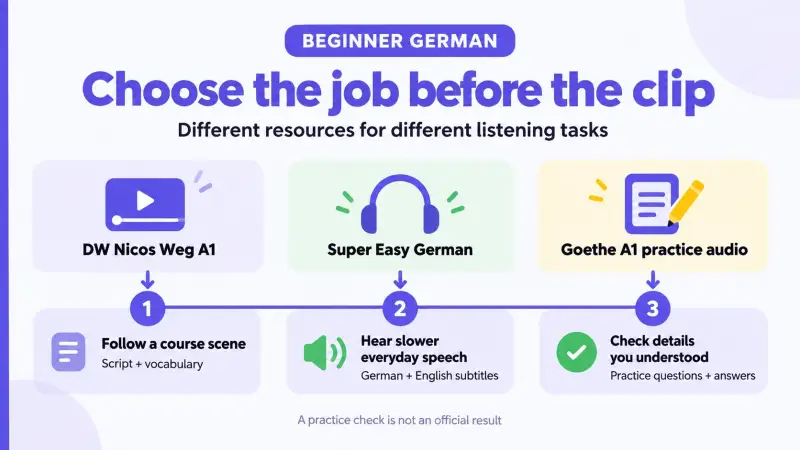
The reason it works as a first listening source is the material that sits beside the video. The script and the vocabulary list for the Hallo lesson are in the same four-page file, so you can look up an unfamiliar word without abandoning the scene and losing track of who is speaking to whom.
Here is a suggested practice cycle for one A1 scene, offered as practice design rather than a tested method. Listen once with the PDF closed and write down, in any language, what you think happened. Listen again with the script open and mark the places where the sound you heard did not match the word on the page. Then read the vocabulary list, close it, and listen a third time with nothing in front of you.
If almost every line is new territory, reversing that order is reasonable: skim the vocabulary list first, then listen. Starting from text does not cancel the listening work, as long as at least one pass happens without it.
Course scenes are recorded for clarity, which is their strength and also their boundary. They will not expose you to every hesitation, overlap or sudden change of subject that comes up between two people talking. If you are weighing this course against app-based study rather than against other audio, the comparison of DW Learn German, Duolingo and HelloTalk handles that question directly.
Super Easy German: Start With Slower Videos and Bilingual Subtitles
This is probably where the clip you closed came from, so it helps to separate two formats that share a brand name. Easy German films interviews with people on the street, and those run at the speed people actually talk. The Super Easy German format is made deliberately slower and simpler.
Easy German's street interviews are recorded at normal conversational speed while the Super Easy German format is produced more slowly, and the videos carry subtitles in German and English. If you picked a video from the channel without checking which format it was, the difficulty was decided before you pressed play.
Those bilingual subtitles are what make the format usable early. A suggested way to work with them: play a short segment and keep your attention on the German line, with the English line covered by a hand or a sticky note, and pause at the first phrase you cannot reconstruct. Write that phrase down as you heard it, then look at the English line and see how far off you were. Guessing before you check is what turns subtitles into practice rather than reading.
One access boundary is worth knowing so you do not plan around something you cannot open. Interactive transcripts and exercises are listed as part of Easy German's membership, not as part of the public videos. The free videos and their subtitles are genuinely usable on their own, and the existence of a beginner playlist does not mean the rest of the channel sits at the same level.
Goethe A1 Audio: Check What You Understand in Short Conversations and Announcements
The first two resources teach you something. This one shows you where you stand, which is a different job and belongs at a different point in the week. The Goethe-Institut publishes free practice material for Start Deutsch 1, the adult A1 exam, and the listening audio in that material is useful even if you never intend to sit the exam.
The Goethe-Institut's Start Deutsch 1 practice page offers a free model set plus two further sets of practice material, including listening audio and a video showing the speaking part. The model set is designed for self-checking rather than as a full A1 course, so it works best once you have already met some of the vocabulary elsewhere. Reviewing the words it throws at you is still worthwhile; it just is not a teaching sequence.
A suggested weekly use: play one listening section cold, with no script and no pausing, answer the questions in the printed material, then count your correct answers against the answer material in the model set. The objective listening tasks can be scored this way on your own. What you get is a practice score that tells you which details slipped past you, not an official certificate result or a full assessment of your German.
Short everyday exchanges and announcements are demanding in a useful way, because they hinge on details: a time, a room number, a platform, a price. Whatever you missed becomes the topic you choose in Nicos Weg or Super Easy German next. The speaking material on the same page is a separate task type with its own preparation, and it is not what these listening sessions are for.
How to Tell Whether a Clip Is Too Difficult Before Committing to It
Everything above assumes you can size up a new clip quickly. Most beginners cannot at first, which is why the same frustrating hour repeats: open a video, struggle, blame yourself, open another video. A short look before you commit replaces that guessing, and it takes a couple of minutes.
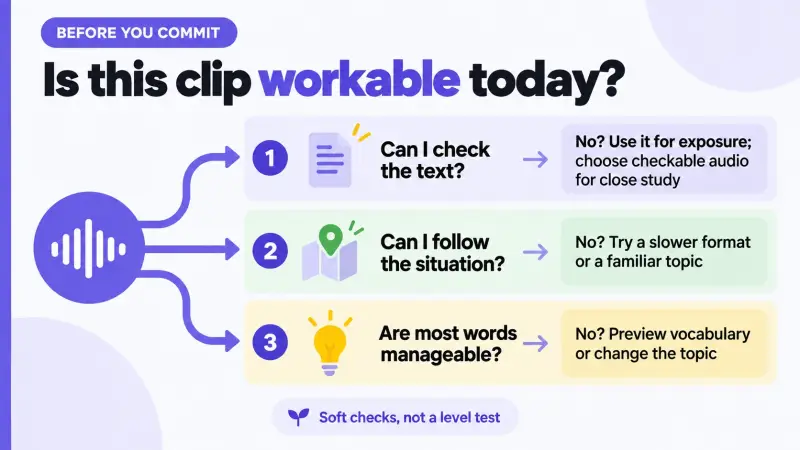
Three questions cover most of it, and none of them produces a verdict on its own. They are soft checks meant to tell you what kind of session a clip suits, not a scoring system.
| What to look at | How to check quickly | What the answer tells you | If the answer is no |
|---|---|---|---|
| Supporting text | See whether subtitles, a script, a transcript or an answer key is available to you right now | Whether you can find out what you misheard afterwards | The clip is still fine for exposure listening; save the close study for clips you can verify |
| Gist after one pass | Play a stretch without stopping, starting with around half a minute and adjusting to your own level, then say aloud who is talking and what the situation is | Whether the speed is workable for you today | Try the slower format from the same source, or a scene on a topic you already know |
| Word load | Scan a few lines of the text, look up a small handful of words, and see whether you can keep going | Whether the gap is vocabulary rather than listening | Pair the clip with vocabulary work on that topic first, or pick another clip on familiar ground |
A clip that feels impossible now is not ruled out permanently; you can bookmark it and come back when the topic has shown up elsewhere. And if the sticking point is content rather than speed, the fix is usually a vocabulary session on that theme rather than more replays.
Listening is one strand of a beginner routine rather than the whole of it. If you are trying to work out where these sessions sit next to vocabulary, grammar and speaking practice, the free German roadmap from beginner to conversational level sets out that sequence.
HelloTalk: Take a Familiar Listening Topic Into a Real Exchange
Recorded audio has a built-in ceiling. Nicos Weg delivers the same line at the same speed every time you replay it, and a practice set never rephrases a question when you look lost. You find out whether a phrase has entered your active German when a person uses it back at you in wording you did not expect.
That is why a language partner belongs at the end of a listening session rather than at some later stage of your German. HelloTalk connects learners with native speakers of the language they are studying, and HelloTalk carries that exchange through text and voice messages, voice and video calls, public Moments posts, and Voicerooms where several people talk in real time.
A suggested five-part cycle for one scene, offered as practice design rather than a promise about results:
-
Source material. Work through one A1 scene, for example the greeting and introduction lesson from Nicos Weg, until you can follow it without the script.
-
Your own expression. Write four original sentences on that topic and send them as a message, or record them as a voice message so your pronunciation is part of what you share. A suggested example: say where you live, what you do in the mornings, and ask the other person what time they usually start their day.
-
A real response. If your partner agrees to trade languages with you, their reply may use word order, fillers or a shortened form that the course scene did not contain, and that mismatch is the part worth keeping.
-
Review. Copy the two or three expressions you could not follow into a notes file, together with anything you wanted to say but could not.
-
Next learning task. Take those gaps into your next clip and choose material on the same theme, so the second listening session has a specific reason behind it.
Moments fits a different moment in that cycle than a private chat. A short public post about the scene you just studied goes out to the community, and replies may come from more than one person or from none, so treat it as a way to see other phrasings rather than a guaranteed source of feedback.
Voicerooms are worth entering as a listener first, since several speakers handling one topic in real time sits closer to the street interview you could not follow than any course recording does. HelloTalk's help documentation notes that subtitle translation in these live formats works by switching subtitles on and then tapping a word.
Keep one thing clear as you go. The people replying to you are language partners, not examiners: they tell you what sounds natural to them, and that is a different kind of information from a practice score. Used together with the recordings, it closes the loop between a script you understand and a conversation you can hold.
Frequently Asked Questions About Free Beginner German Listening
Is Easy German suitable for absolute beginners?
Partly, depending on the format. The Super Easy German format is produced more slowly and simply and is workable at a beginner level, while Easy German's street interviews are recorded at normal conversational speed and are considerably harder. Check which format a video belongs to before pressing play, because the channel as a whole is not pitched at A1.
Are the video subtitles, the downloadable script and the interactive transcript the same thing?
No. Subtitles are the text shown on the video itself, and Easy German's videos carry them in German and English. A downloadable script is a separate file, as with the four-page PDF DW provides for the first Nicos Weg A1 lesson, which also contains a vocabulary list with English glosses. Interactive transcripts and exercises are listed under Easy German's membership rather than as free access.
Can I use the Goethe A1 listening audio if I am not taking the exam?
Yes. The Start Deutsch 1 practice page offers a free model set and two further practice sets with listening audio, and you can play the audio and answer the questions purely as a self-check. Score the objective items yourself against the answer material, and read the result as a practice check on which details you caught, not as an official exam result.
Should I listen with the text or without it?
Both, in one session. A useful default is one pass without text so you find out what you genuinely caught, then a pass with the subtitles or script to see where your ears were wrong. If nearly every word is new, skimming the vocabulary or scanning the script first is a sensible way in; reading along does not waste the practice as long as at least one pass happens without text.
Nicos Weg or Super Easy German first?
Nicos Weg is the easier starting point if unbroken speech is your main obstacle, because the A1 scenes are short and come with a script you can check yourself against. Super Easy German is a good next step once you can follow a course scene without the text, since it brings in everyday speech on video with bilingual subtitles to lean on.
How much German listening per day makes sense at A1?
A workable suggestion rather than a researched figure: one short clip worked through properly beats an hour of background audio. Fifteen focused minutes with three passes over the same scene gives you something specific to notice. How often you check a guess against a script matters more than total minutes.
How do I move from listening to speaking without waiting until I feel ready?
Use the material you already know as the script for your first exchange. After finishing an A1 scene, send four original sentences on that topic to a language partner as text or as a voice message, then note which parts of the reply you could not follow. HelloTalk supports both message types as well as Moments posts, so you can start in a private chat or post publicly, depending on how exposed you want the first attempt to be.