
Free Goethe A1 Speaking Practice: Official Materials and Partner Tasks for Each Exam Part

The card lands face up with a theme and a single prompt word on it, something like shopping and Markt. You know both words. What does not arrive is a question, and the person opposite is waiting for one, not for the introduction you spent a week rehearsing.
The material that trains that exact moment is already published and free to download. This article stays on the adult Start Deutsch 1 speaking exam, walks through the official free materials part by part, and separates what you can drill alone from what only happens when someone answers back.
Start With Goethe's Free Model Paper, Speaking Video, and Practice Sets
Get the source documents before you build any routine, because the format itself is the thing most people end up guessing at.
The Goethe-Institut publishes its Start Deutsch 1 preparation material free on its own website, including a complete model set, two further sets of practice material, listening audio, and a video showing the speaking exam being conducted. Each one does a different job. The model set carries the task instructions and the assessment principles, the video shows the sequence and how candidates hand a turn to each other, and the extra practice sets give you prompts you have not already memorised.
Two format facts shape everything below. Goethe's official speaking page describes three parts and roughly 15 minutes for the standard format, and the official model paper notes that the speaking exam is taken with up to four candidates and two examiners. The same official page states that candidates may not use a dictionary or a phone during the exam, so at some point your practice has to run without lookups.
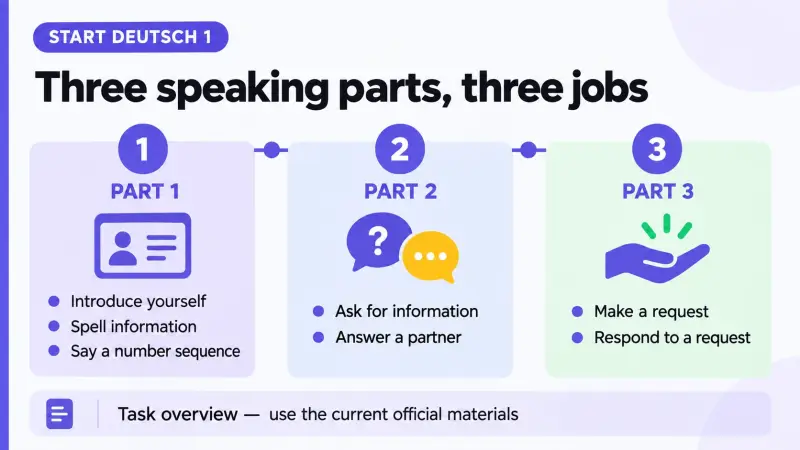
The three parts always come in the same order: part one is about you, part two is a question-and-answer exchange built on cards, and part three is about making a request and answering one. If you are still assembling the rest of your beginner set, the wider roundup of free German resources for beginners online covers reading, grammar and course options, while this page stays on speaking.
Here is how the free materials line up against the three parts, and where a second person becomes necessary. Read the middle column for solo work and the last two columns for what only shows up in an exchange.
| Official material | What it prepares | What you do alone | What you do with a partner | What you check against |
|---|---|---|---|---|
| Start Deutsch 1 model set | All three parts | Read the speaking instructions end to end, then time one full run | Run the three parts in order without stopping | The task instructions and assessment principles printed in the set |
| Speaking exam video | Sequence and pacing | Watch once for the order, once for how candidates open and close a turn | Agree who speaks first in each part before you begin | Whether your run follows the same turn order |
| Two extra practice sets | Parts two and three | Build question forms from prompts you have not seen before | Swap prompts so neither person knows the other's card | Whether a full question was produced and answered |
| Listening audio from the same materials | Extra exposure to exam-level phrasing, suggested here rather than tied by Goethe to a speaking part | Listen for question forms and everyday wording | Ask your partner to put a similar question to you live | Whether you answered the question that was actually asked |
The model set is where you should start reading, and part one is where it starts.
Part 1: Introduce Yourself and Respond to Questions About You
Part one is the only section you can genuinely pre-build, which is why a memorised block feels safe right up to the moment someone asks you for something you did not script.
Prepare it as a set of short independent sentences instead of a paragraph. Suggested practice: write eight to ten basic facts about yourself, one sentence each, and record them in a different order three times. If you can only say sentence four after sentence three, you have memorised a text rather than a set of facts.
An original example in that style, written as practice material and not as exam content: Ich heiße Emma Wright. Ich komme aus Irland. Ich wohne in Bremen. Ich arbeite in einem Café. Ich lerne seit acht Monaten Deutsch. Each line stands on its own.
The official model paper's part one has three elements: your introduction, spelling one piece of information such as a name or place of residence, and giving a set of numbers such as a telephone or house number. The spelling and the numbers are easy to skip in solo practice and awkward to improvise on the day, so rehearse them directly. Say the German letter names for your own surname and city out loud until they come without a pause, then say a number sequence slowly and clearly. Use invented digits when you practise with someone new, and keep any real number out of a public post.
Beyond those three official elements, short answers about what you just said are worth having ready as optional practice: Seit einem Jahr. Nein, aus Irland. Ja, jeden Tag. A repair line is the other piece I would rehearse, in the formal form you would use with an examiner: Entschuldigung, können Sie das bitte wiederholen? Neither is an extra task the official part one description lists, but both keep you moving when a question arrives faster than you expected.
Part 2: Use Topic Cards to Ask for and Give Information
Part one rewards preparation. Part two removes it, because the prompt on the card is one you see for the first time in the room.
The official description of this part is asking for and giving information, and the model set builds it around cards that give a theme and a prompt word. Download the current model set and read the card instructions yourself, since the wording in the current official file is what counts on the day.
The underlying skill is narrower than it looks. Three or four question frames that accept almost any noun will carry you further than a memorised list of questions. Suggested practice: take one prompt word, write the same question three ways, and say all three out loud before moving to the next word.
Using the theme of shopping and the prompt word Markt, an original set might run: Gehen Sie oft auf den Markt? Was kaufen Sie auf dem Markt? Wann gehen Sie auf den Markt? One asks yes or no, one asks for a thing, one asks for a time. Keeping the same formal form across all three is easier to rehearse than switching between du and Sie inside one template.
Then practise the answering side, which is half the task. A bare Ja leaves your partner with nothing to work with, so attach one detail: Ja, am Samstag. Ich kaufe dort Obst. Two short sentences are plenty at this level.
If your questions keep collapsing at the verb, that is word order rather than vocabulary, and my suggestion would be to fix it away from the cards instead of running more prompts. A round of free German grammar resources that actually stick is a practical place to do that kind of session.
Part 3: Make a Request and Respond to Someone Else's
Part two trains asking for information. Part three changes the goal: you ask someone to do something, and you react when they ask you.
In the official material the request prompts are short everyday actions, and one polite sentence with bitte is enough. What matters is that the other person can understand it and act on it, so do not sacrifice a clear phrase in order to build a longer one.
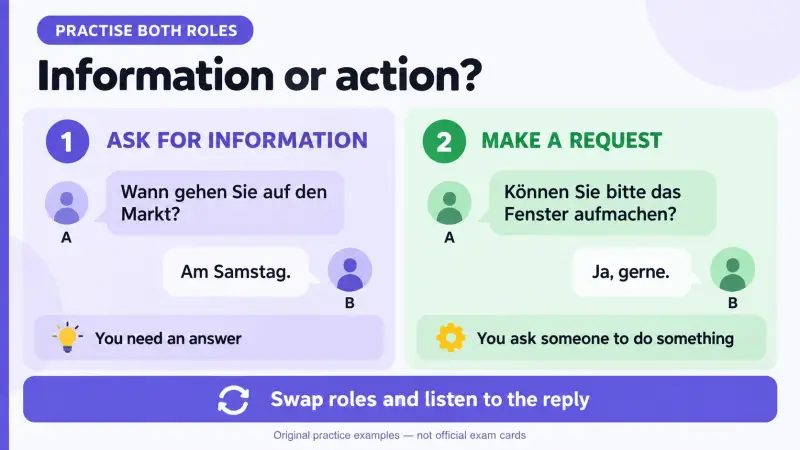
Prepare two polite request frames and reuse them everywhere. Original examples: Können Sie mir bitte helfen? and Können Sie bitte das Fenster aufmachen? Since the people in the room are strangers, the formal Sie is a sensible default to rehearse, and keeping one form throughout is simpler than deciding mid-sentence.
Responding needs its own rehearsal. Prepare one clear yes, one clear no, and one holding line: Ja, gerne. Tut mir leid, mir ist kalt. Moment bitte. A short Ja, gerne is already a complete answer, and a reason is useful when you have one rather than obligatory every time.
Suggested practice for the week before a test date: pick ten everyday objects around your home, make a request about each one out loud, then answer each request as the other person. Ten pairs takes only a few minutes and forces you through both roles.
HelloTalk: Turn the Official Tasks Into Two-Way Practice
A recorder lets you hear yourself. What it cannot produce is a reply you did not write, at a speed you did not choose, using a word you have not studied yet.
HelloTalk is one place to add that second voice to the same preparation cycle. The HelloTalk platform carries text and voice messages, voice and video calls, and Moments, a public feed where you can post a short written version of your introduction before you say it out loud. HelloTalk also hosts voice rooms, live audio with several people at once, which you can enter as a listener first if speaking to a stranger still feels early.
Ask before you start rather than sending a task cold. A line like Ich lerne für Start Deutsch 1. Haben Sie 10 Minuten Zeit zum Üben? gives the other person a real choice and sets the length. From there, one round looks like this:
-
Take one task straight from the model set or the practice sets, for example a part two card theme, without softening it into something easier.
-
Run that part with both roles, then swap: you ask and they answer, then they ask and you answer.
-
Say out loud where you lost the thread, and ask what they did not understand in what you said.
-
Turn those two spots into the week's study item, then bring the same card back a few days later and run it again.
A partner can tell you what they understood and where they lost you, which is real information you cannot get from a recording alone. Results against the official Goethe criteria are assigned by trained examiners at a test centre, not by a practice partner. Some partners are teachers and can say more, and a qualified teacher is the right person to ask for a closer estimate before you register.
Structure and live conversation solve different problems, and it helps to know which one you are short of this month. The comparison of DW Learn German, Duolingo and HelloTalk puts a structured course, an app habit and live exchange side by side without pretending one replaces the others. If you have been preparing alone so far, the most useful next step is arranging one short exchange this week and bringing the card you fumbled.
Use the Official Criteria to Review a Practice Recording
You now have recordings. Without a reference point they are just audio you feel vaguely bad about, so borrow the reference point the model paper already gives you.
The official Start Deutsch 1 model paper describes speaking assessment in three bands: a task completed appropriately and comprehensibly, a task only partly completed because of gaps in language or content, and a task not completed and/or not comprehensible. That is deliberately blunt, and for self-review it beats an invented percentage, because it asks one question about each recording: did the task actually happen, and could it be understood?
Apply it to one recording per part rather than to everything you have. The three bands come from the official model paper; the listening prompts and follow-up items below are practice suggestions written for this article, not official scoring guidance.
| Part | Listen for this in your recording | Ask yourself | If the answer is no, practise this next |
|---|---|---|---|
| Part 1 | The introduction, the spelled item, and the number sequence | Did all three come out, and could someone write down the spelling and the digits from my audio? | Spelling and numbers on their own, slowly, until both are clear without a restart |
| Part 2 | The question you produced and the answer you gave to theirs | Did a full question come out, and did my answer give them something to reply to? | One prompt word, three question shapes, said out loud before moving on |
| Part 3 | The request and your response to theirs | Was the request clear enough to act on, and did my response give a plain yes or no? | Two request frames and three responses, alternating roles on ten objects |
Two habits make the review faster. Do one pass without pausing the recording, marking only the places where a task did not happen, then a second pass for the language details, otherwise the whole session goes on one mispronounced word. Run at least one full practice with no notes, dictionary or phone open, since the official page states those are not available during the exam.
When the same gap shows up twice in a row, that gap becomes the task you bring back to your partner. Before your test date, check the current official documents on the Goethe-Institut site for exam rules and assessment details, because the version published there is the one that applies.
Frequently Asked Questions About Free Goethe A1 Speaking Practice
Are the Goethe A1 speaking materials really free to download?
Yes. The Goethe-Institut publishes Start Deutsch 1 preparation material on its own website, including a full model set, two additional practice sets, listening audio, and a video showing the speaking exam. You download them directly, and they are separate from registering for the exam itself.
Is Start Deutsch 1 the same exam as Fit in Deutsch?
No. Start Deutsch 1 is the adult exam at A1, and Fit in Deutsch is aimed at younger candidates. Everything here refers to the adult Start Deutsch 1 materials, so check which set you downloaded before building your practice around it.
How long is the speaking part, and how many people are in the room?
Goethe's official speaking page describes three parts taking roughly 15 minutes in the standard format, and the official model paper notes that the speaking exam is taken with up to four candidates and two examiners. You will therefore spend part of the time listening to other candidates, which is one more reason to practise reacting rather than reciting.
What happens in part one besides introducing myself?
The official model paper's part one adds two short items after the introduction: spelling one piece of information, such as a name or place of residence, and giving a set of numbers, such as a telephone or house number. Both are worth rehearsing separately, using invented digits when you practise with someone you have just met.
Can I prepare for the speaking exam completely alone?
Partly. Your part one material, your spelling and numbers, and a stock of question frames for part two are all trainable alone, and recording both sides of a request exchange covers some of part three. What solo work cannot produce is an unpredictable reply at conversational speed, so plan a few rounds with another person before your test date.
Can a language partner tell me whether I would pass?
A partner can tell you what they understood, where they lost you, and whether your question made sense. That is useful feedback, but it is not formal assessment; assessment against the Goethe criteria is done by trained examiners at a test centre, and a qualified teacher can give you a closer estimate beforehand.
What if I understand the question but cannot answer fast enough?
Rehearse a small number of lines until they are automatic, such as asking the person to repeat the question in the formal form, or saying Moment bitte while you assemble the sentence. Aim for an answer the other person can follow rather than a fast one, and treat this as practice advice rather than a prediction about points.