
Italian Resources Before a Trip: Learn What to Say and Understand the Reply
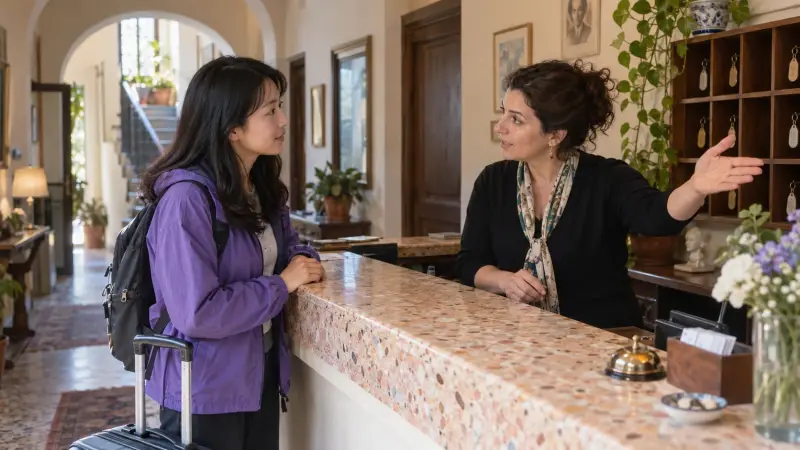
You order at the bar with the one line you practised, "Un caffè, per favore," and it comes out fine. The barista answers with a short question, and you are suddenly guessing: was that about paying, about standing at the counter, about something else entirely? The line you prepared worked. The half you did not prepare is the half that decides what happens next.
So the resource question before a trip is narrower than "how do I learn Italian." You want material that gives you both sides of a small set of transactions: ordering, checking in, asking the way. Three named resources cover that combination between them, and they do different jobs: OpenLearn's Andante beginners' Italian for dialogues you can read as well as hear, selected Coffee Break Italian episodes for travel topics with spoken explanation, and conversation practice with real speakers on HelloTalk for replies that were not written in advance.
Quick Picks: OpenLearn Andante, Coffee Break Italian, and HelloTalk
Before the detail, it helps to see what each one actually gives a traveller, because they are not substitutes for each other. Read the table along four questions: which travel topics the material covers, whether you get the dialogue in writing, whether anything in it makes you answer rather than listen, and where it fits in the weeks before you fly. The last column is a suggested order of use, not a ranking of quality.
| Resource | Travel topics covered | Dialogue and transcript support | Does it make you answer? | Suggested point of use |
|---|---|---|---|---|
| OpenLearn Andante (beginners' Italian) | Six audio tracks, including ordering food and staying at a hotel | Each track page provides its own transcript | Only if you deliberately rehearse the other speaker's lines | First, as your fixed base material |
| Coffee Break Italian, Season 1 | Lesson list includes restaurants, hotels and directions, with episode 14 on booking into a hotel and episode 18 on asking for directions | Audio lessons with spoken explanation; lesson notes, bonus audio and video extras belong to the separate Academy course | Not directly, though the phrasing is unpacked so you can vary it yourself | Second, to widen the wordings you can recognise |
| HelloTalk | Whichever scenario you and a partner agree to set up | Text and voice messages, voice and video calls, public Moments posts | Yes, because the follow-up is not scripted | Alongside the other two, and more often as departure nears |
The first two give you fixed, checkable material you can return to as many times as you like. The third is where that material has to survive contact with someone who has not read it.
OpenLearn Andante: Work Through Food and Hotel Dialogues With Transcripts
Start with fixed audio that comes with a written version, because that pairing lets you find out precisely which words your ear missed rather than concluding vaguely that it went too fast. OpenLearn's Andante beginners' Italian course is built around six audio tracks that include ordering food and staying at a hotel, and the individual track pages, such as the second and the fourth, each provide their own transcript. You do not need to work through the whole course. Two tracks that match your itinerary are enough material for several sessions.
What matters is the order in which you use the audio and the transcript. Here is a suggested practice session of roughly 20 minutes per track, written for this article rather than taken from the course guidance, and offered as a suggestion rather than a tested method:
-
Play the track once with the transcript closed, and write down every word you think you caught, including the ones you are unsure about.
-
Open the transcript and check your list. Separate two kinds of misses: words you have never met, and words you know on paper but did not recognise in speech. The second group is the one worth drilling before a trip.
-
Mark the lines spoken by the waiter or the receptionist, since those are the lines you will be hearing rather than saying.
-
Play the track again reading only the staff lines out loud, and say your own line from memory in the pause.
Reading the other person's lines aloud is what gives you a feel for the shape of their questions, which is the thing you need to recognise quickly when it is a live voice rather than a recording. If you want to see how a travel goal sits alongside longer-term study, the guide to learning Italian quickly in 2026 covers the wider routine this fits inside.
Coffee Break Italian: Select Lessons on Restaurants, Hotels, and Directions
Andante gives you a dialogue to dissect. Coffee Break Italian adds a different kind of help: someone explaining why a phrase is built the way it is and offering variants of it, which is useful when the person in front of you does not use the version you memorised.
Coffee Break Italian's Season 1 lesson list includes restaurant, hotel and directions topics, with episode 14 on booking into a hotel and episode 18 on asking for directions, and the free audio podcast is a separate level of access from the Academy course materials such as lesson notes, bonus audio and video extras. Treat those as two things rather than one bundle, and check the official episode page for what is included before you build a plan around it.
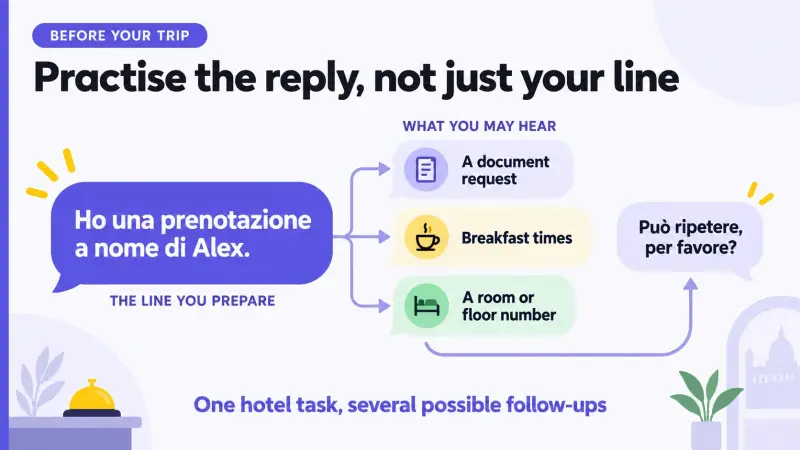
For a trip, be selective. Pull the two or three lessons that match what you will actually do and leave the rest of the season for later. A suggested exercise after each episode: write three ways to make the same request, from the most polite to the shortest, plus three replies you might plausibly get back. For a hotel that might be a request for your document, the breakfast hours, or a room number with a floor. Writing the replies yourself turns a passive listen into a small prediction you can test on a real person later. If you are also assembling everyday tools around these lessons, the rundown of a faster Italian learning stack covers how course audio and daily practice fit together.
Practise Both Sides of Ordering, Checking In, and Asking the Way
That coffee bar moment has a structural cause rather than a vocabulary one. A travel exchange has two moving parts, the request you prepare and a reply that can arrive as a choice, a question about numbers or times, or an instruction, so rehearsing only your own line leaves half of the exchange untrained. Choices and numbers are worth extra attention because they are short, they go by fast, and they carry the information you need to act on.
The table below is a suggested rehearsal design written for this article, not material taken from either course. Prepare the second column, drill the third until the shapes are familiar, and keep the fourth ready so a gap does not end the exchange.
| Travel task | Line you prepare | Reply shapes worth rehearsing | If you lose the thread |
|---|---|---|---|
| Ordering at a bar or restaurant | "Vorrei un caffè, per favore." or "Un tavolo per due, per favore." | A choice: "Al banco o al tavolo?" A number: "Quante persone?" A time: "Per che ora?" | "Più lentamente, per favore." |
| Checking into a hotel | "Ho una prenotazione a nome di Alex." | A document request: "Mi può dare un documento?" A schedule: "La colazione è dalle sette alle dieci." A room detail with a floor number | "Può ripetere, per favore?" |
| Asking the way | "Scusi, dov'è la stazione?" | An instruction: "Sempre dritto, poi la seconda a destra." A distance: "È a dieci minuti a piedi." A question back: "Quale stazione?" | "Me lo può scrivere?" |
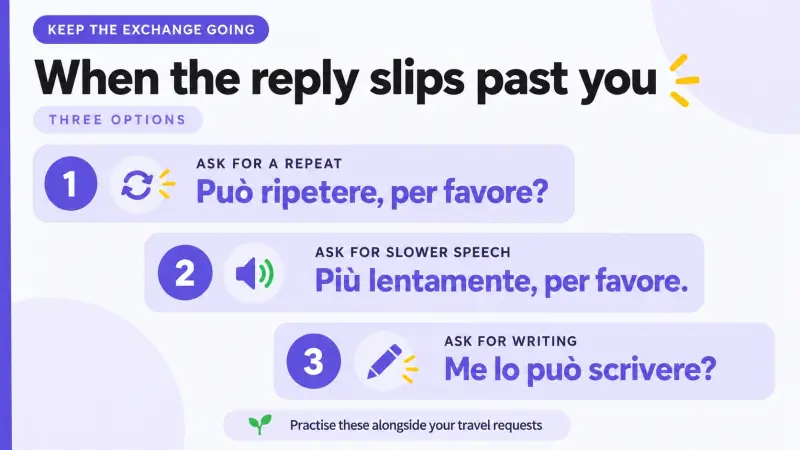
Two drills work without anyone else involved. Record the reply column on your phone, come back to it after a day or two, and answer out loud in the pauses, with the aim of answering the audio rather than reciting a sequence you have just read. Then drill numbers one to twenty, the hours, and the handful of direction words, since a reply you half understand is often one where a number or a time slipped past.
Both drills are limited in an obvious way: your own voice reads at your own pace, and the wording never changes. They still build the recognition you want, and they are worth doing before you spend live conversation time on the same material. If you are still deciding which grammar to carry into all this and which to leave for after the trip, the broader piece on how to learn Italian quickly is a reasonable reference point.
HelloTalk: Practise Unscripted Follow-Up Questions Before You Travel
Repeated listening and imitation are genuine study, and knowing a track well is not wasted effort. The limit is narrower than it sounds: one recording gives you one person, one speed and one set of words, so a hotel reply you can follow perfectly on the Andante track may still arrive differently from a receptionist who phrases it another way. Meeting a second and a third version of the same exchange before you travel is what closes that gap.
HelloTalk supports text and voice messages, voice and video calls, and public Moments posts, and the platform also hosts Voicerooms for live multi-person audio and Live broadcasts. That range matters because it lets one practice cycle run end to end rather than stopping at a corrected sentence. A suggested shape for a single session, arranged in advance with a partner who has agreed to role-play:
-
Bring the source material. Tell your partner which scenario you have been working on, for example the hotel stay from the Andante track or the phrases from the Season 1 hotel lesson.
-
Produce the line yourself. A voice message works when your schedules do not overlap, and a call adds the pressure of answering in real time.
-
Ask them to change the follow-up each round: sometimes a choice, sometimes a question about timing, sometimes a small complication such as a different room or a full restaurant.
-
Write down the exact point where you lost it. Not "I did not understand," but "I missed the word straight after colazione."
-
Go back to the transcript or the episode, find that word, and make it the next thing you study, then run the same scenario again in a later session.
That last step is the reason to do this before the trip rather than during it. The course material feeds the conversation, the conversation shows you which part of it has not stuck, and what you noticed decides which vocabulary or which lesson you work on next. Exchange works both ways, so plan on spending part of the session helping your partner with your own language.
Moments is worth using alongside the sessions rather than instead of them. A short public post asking how staff usually phrase a particular question gives other speakers an easy thing to answer, and if replies come in you can collect the different wordings next to your transcript notes. These role-play tasks are practice between learners and speakers who agreed to help, not a formal assessment of your level, and people have their own schedules, so arrange sessions ahead rather than counting on someone being free the evening before you fly.
What to Prioritise When Departure Is Close
With several weeks in hand you can take all of the above in a relaxed order. When the trip is close, the useful move is to narrow the scope rather than add to it. Three priorities are enough, and they are listed in the order I would protect them if time runs short, not as stages you finish and leave behind.
First priority is understanding replies: numbers, times, direction words, and the few question shapes in the table above. Second is your own requests, one solid version per task rather than five polite variants you half remember. Third is everything else, which in a final week means grammar tables, tenses beyond the present, and vocabulary not attached to something you will actually do.
With about two weeks, a workable shape is two Andante tracks with transcript work, the two or three matching Coffee Break Italian episodes, and whatever partner sessions you can genuinely arrange in that window. With about three days, keep four things and drop the rest: play your chosen recordings, rehearse your requests out loud, check the reply shapes, and practise the clarification lines. Both timings are adjustable examples rather than a schedule, and if no partner has confirmed yet, the self-recorded and course audio drills still let you practise both sides.
Handling a few travel tasks is task familiarity rather than general fluency in Italian, and the two are not the same target. The concrete aim before departure is a request you can produce without rereading it, a set of reply shapes you recognise, and a clarification line ready for the moment you do not. Some exchanges will still need a repeat, a written note, or a switch to a shared language, and that is a normal part of travelling with limited Italian. If the unscripted half is the piece you are missing, HelloTalk is where a line you took from a transcript can meet a real reply while you still have time to go back and review what slipped past.
Frequently Asked Questions About Learning Italian Before a Trip
Which resource should I start with if my trip is three weeks away?
A reasonable starting point is OpenLearn's Andante beginners' Italian, specifically the tracks on ordering food and staying at a hotel, because each track page has its own transcript and you can check exactly which words you failed to hear. Add the Coffee Break Italian Season 1 lessons that match your itinerary, such as episode 14 on booking into a hotel or episode 18 on asking for directions. Arrange conversation practice for the later part of the three weeks, once you have material to bring to it. This is a suggested sequence rather than a tested schedule.
Is the free Coffee Break Italian podcast enough, or do I need the course materials?
They are different levels of access: the audio podcast is free, while the Academy course adds lesson notes, bonus audio and video extras as separate materials. For three travel tasks, the audio lessons give you the phrases and an explanation of how they are put together, which is the part you need in order to vary them. The written extras suit people who prefer reviewing from notes rather than replaying audio. Check the official page for what a given episode includes before planning around it.
How can I practise understanding replies if I have no Italian-speaking partner yet?
Use the transcripts in reverse. Read the waiter's or receptionist's lines aloud, record them, come back to the recording after a day or two, and answer out loud in the pauses. This builds familiarity with the shape of common questions, though your own voice will not reproduce another speaker's pace or accent, which is why a live conversation before you travel still adds something the recording cannot.
What should I say in Italian when I do not understand the reply?
Keep three lines as ready as the request itself: "Non ho capito," "Può ripetere più lentamente, per favore?" and "Me lo può scrivere?" Saying "Parlo poco italiano" early in the exchange is worth trying, since some people will adjust how they speak and others will not. Having these ready is what keeps the exchange going instead of ending it in silence.
How is practising on HelloTalk different from replaying course audio?
Course audio is fixed, which is what makes it good for checking your ear against a transcript, and replaying it is real practice. What it cannot do is vary, so on HelloTalk a partner who has agreed to role-play can change the follow-up question each round through voice messages or a call. The value is the whole cycle: you take a phrase from your course material, use it, hear a response you did not write, note exactly where you lost the thread, and turn that into the next thing you study.
Will learning travel phrases make me conversational in Italian?
Handling ordering, check-in and directions is familiarity with a few tasks, which is genuinely useful on a trip but is not the same as holding conversations across general topics. It does give you a set of situations you can already perform, and some people build outward from those into broader study once they are back. Treat it as a starting base rather than a shortcut to fluency.
How much grammar do I actually need before a short trip?
Enough to recognise a question when you hear one and to make a polite request, which in practice means the present tense, forms like "vorrei" and "posso avere," and the question words for where, when, how much and how many. Fuller conjugation tables and the past tenses can wait until after the trip, when you have conversations to attach them to.