
English Audio Resources for a Short Commute: What Can You Use Without Watching a Screen?

One hand is on the rail, the other is holding your phone, and the episode you just started assumes you are reading along with the transcript on the page. You cannot, so you listen anyway, and by your stop you have heard a lot of English without keeping hold of a single line of it. For a ride of fifteen or twenty minutes, three named resources cover most of what that journey can realistically carry: British Council Podcasts for following a conversation, Coffee Break English for hearing a phrase explained as it comes up, and HelloTalk for turning either one into an exchange with a person once you are off the train.
The parts of a listening routine that need reading, tapping or typing are the parts to move out of the ride itself, because a standing commute gives you no dependable screen time in between.
Quick Picks: British Council Podcasts, Coffee Break English, and HelloTalk
Two of these three give you input of different kinds, and the third gives you a person who reacts to the topic you just listened to. Read the table by the column that matches where your routine breaks: by "where it fits" if you never know what to choose, by "when the text is used" if you keep losing the thread at the same points, and by the last column if episodes end and nothing reaches your own speech.
| Resource | Where it fits | Audio format | When the text is used | Screen moments | Next task with a real person |
|---|---|---|---|---|---|
| British Council Podcasts | Learners who already handle everyday English; the LearnEnglish audio series section is labelled for A2 and B1 | Conversation episodes published as a series | After the ride, for a second look at one or two spots you missed | Choosing the episode beforehand, opening the transcript and exercises later | Retell the situation in three sentences, including your own reaction, and ask one question |
| Coffee Break English | Learners who can follow a host explaining in English while they listen | Free podcast with slower delivery and spoken explanation of phrases | No text needed during the ride; the free podcast audio is what this covers | Queueing the episode in whichever podcast player you use | Say the explanation in your own words and ask a partner how they would use the phrase |
| HelloTalk | Depends on the topic you choose and what your partner is willing to talk about | Text and voice messages, voice and video calls; Voicerooms and Live sessions if you would rather listen in | After you are seated, when you can type a follow-up question | Recording and sending once you arrive, tapping a word to translate a subtitle in a Voiceroom or Live session | Send your three sentences and a question, and answer whatever they ask you back |
This is a split of tasks rather than a ranking, and none of the three is a full study plan on its own. If you are still assembling the wider set of tools you use during a day, the broader shortlist sits in this overview of English learning apps for quick daily practice; the three above are the part of it that survives a journey with no screen.
British Council Podcasts: Follow a Conversation and Check the Transcript Later
The British Council's LearnEnglish site publishes these podcasts inside an audio series section, with a transcript and comprehension exercises attached to each episode page. That is exactly the split a commute needs: the audio stands on its own during the ride, and the reading waits for you instead of competing with it.
The British Council podcast section is labelled for A2 and B1 learners, so it assumes you already manage everyday English rather than starting from zero. If whole minutes go past with almost nothing recognisable in them, that points to a level mismatch, and the lower-level listening pages on the same site, which pair a short recording with preparation and comprehension tasks, are the better entry point.
Give yourself one job per journey instead of trying to catch everything. Suggested practice: listen once without stopping and hold on to a single exchange you half caught, for example a line where someone changed their mind about a plan. Afterwards, open the transcript, find that spot, and read only the ten or fifteen words around it.
Episode lengths vary across a series, so check the length against your trip before you start playback. It also helps to remember that this is listening work specifically; how listening, speaking, reading and writing tend to move at different rates is broken down in this guide to building English fluency skill by skill.
Coffee Break English: Listen With Guided Explanations
Some mornings you do not want to decode a natural conversation at full speed. You want someone to slow down and explain why a phrase works the way it does, without handing you a worksheet.
Coffee Break English publishes a free English podcast with slower delivery and a host who explains expressions as they come up, which means the explanation reaches you as audio rather than as something to read. You listen through an ordinary podcast player, not inside a lesson interface, so nothing in the format requires your eyes.
One caveat about levels: the publisher's own labelling is not consistent between its navigation and its episode descriptions, so treat a season number as a rough signal rather than a fixed level. A simpler test works better on a train. If you can follow the host's explanation without notes in front of you, the episode fits the ride.
There is a side benefit worth noticing. Because the explanations are in English, you pick up the language used to talk about language, phrases along the lines of "we usually say this when" or "that sounds a bit formal". That is the vocabulary you need later when you want to describe your own difficulty to another person instead of going quiet about it.
HelloTalk: Continue the Topic With Voice Messages After Your Journey
Here is where commute listening often stops short. The episode ends, the app closes, and the material never leaves your ears. A transcript or a replay of your own recording covers part of the review honestly: you can check the line you missed, and you can hear where your own version went flat.
A transcript or your own recording shows you what you missed; a reply from another speaker adds phrasing and follow-up questions you did not plan for.
HelloTalk carries text and voice messages plus voice and video calls, so the loop after a ride can be short: retell the situation from the episode in a voice message, read or listen to whatever comes back, and note the expression you did not have along with the part you could not catch. How much you take on depends on the topic you picked and what your partner is up for, since these are exchanges between learners rather than lessons available on demand, and answering their message in return is part of the deal.
HelloTalk's Moments feed covers the other half. When one phrase from the audio keeps bothering you, posting it publicly with a short question puts it in front of more than one speaker at a time, which is useful when a single chat has gone quiet. If you would rather listen than post on a given day, HelloTalk's Voicerooms are real-time multi-person audio rooms and its Live sessions are real-time broadcasts. HelloTalk's subtitle translation in those formats works by turning subtitles on and then tapping the word you want, so plan that for a moment when you are seated.
What Needs a Screen Before, During, and After Listening?
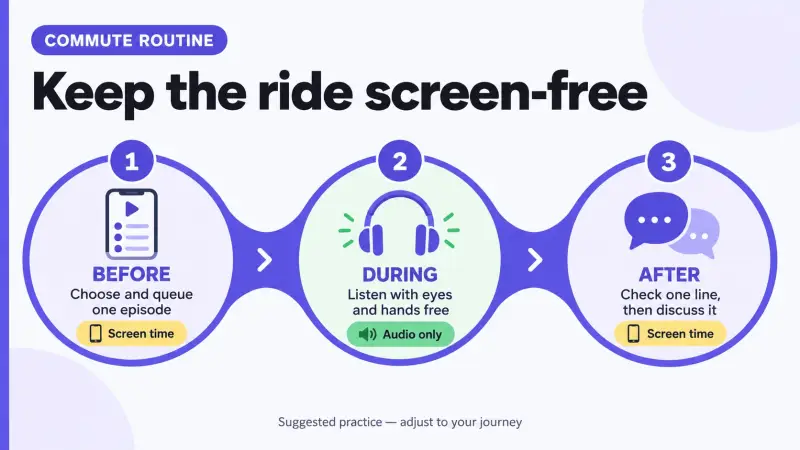
Three moments in this routine touch the screen, and they are not equal. Setup happens before you leave, the ride itself can be designed to need nothing, and the reading and recording belong to the minutes after you arrive. The table below maps each stage to the resources involved and to what tends to go wrong when that stage gets skipped, so you can see which one your current routine is missing.
| Stage | What it involves | Which resource it applies to | What tends to go wrong if you skip it |
|---|---|---|---|
| Before you leave | Choose the episode, check its length against your trip, start playback while you are still standing still | British Council Podcasts and Coffee Break English | You scroll a feed instead, start playback several minutes into the ride, or open an episode twice as long as the journey |
| During the ride | Listening straight through, with eyes and hands free | The podcast audio you queued in advance | Taps you planned for mid-journey cost you the passages you wanted to hear |
| After you arrive | Open the transcript for one spot, replay it, record a voice message, read the reply | British Council transcripts and exercises, then HelloTalk voice messages and Moments | The episode stays passive input and none of it reaches your own speaking |
One practical limit worth settling in advance: whether an episode can be downloaded, controlled from a lock screen or kept playing in the background depends on what the service offers and on your player and phone settings. Run your setup once at home, on a day when losing the audio costs you nothing.
Turn One Audio Segment Into Something You Can Discuss
The link between hearing something and being able to say it is not automatic. Input does real work, since repeated exposure is what makes a phrase recognisable, but it does not stand in for practising your own version and handling what comes back. The five steps below are suggested practice rather than a tested method, and they are built for the few minutes after you get off, not for a dedicated study block.
-
Pick one moment from the episode rather than the whole thing: a change of plan, a polite refusal, a request that had to be repeated.
-
Once you are off the train and sitting somewhere stable, say three sentences out loud or record them directly. Sentence one is what happened, sentence two is the phrase you noticed, sentence three is your own reaction to it.
-
Add one follow-up question aimed at a person. "How would you say that to a friend?" gives someone more to work with than "is this correct?"
-
If a reply comes, mark the one expression in it that you did not already have, along with anything you could not catch.
-
Carry both into the next commute as the thing you are listening for.
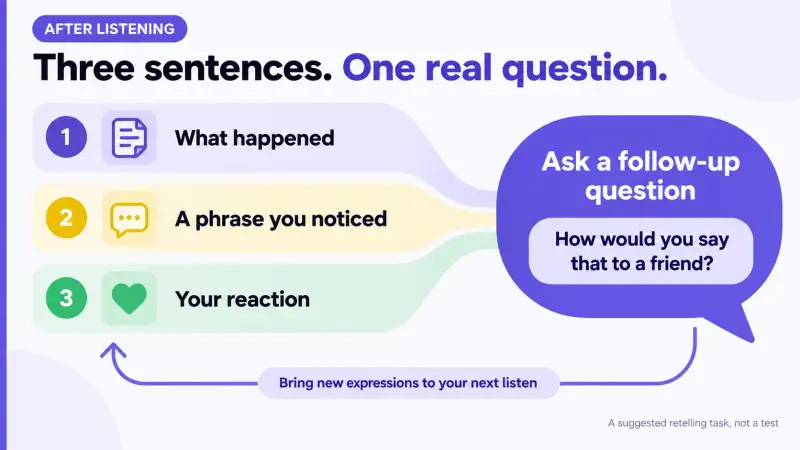
An original example shows the shape. Say the segment involved two friends moving a weekend plan to a different day. Your three sentences could be: the conversation was about two friends changing a plan at short notice; one of them said something close to "let's push it to Sunday"; I would have said "let's change the day", which sounds heavier to me now. Then the question: when you move plans with a friend, what do you actually say?
That takes under a minute to record once you are seated, and it gives a partner something concrete to react to rather than a general request for correction. If those few minutes start to feel too tight and you want a longer block at home, the extended version of the same loop is laid out in this 30-minute daily English speaking routine. When the three sentences are ready, sending them as a voice message on HelloTalk puts your version of the topic in front of someone who speaks the language, and whatever comes back becomes the material for tomorrow's listening.
Frequently Asked Questions About English Audio Practice on a Commute
Are British Council Podcasts suitable for a complete beginner?
Not as a first step. The British Council publishes those podcasts in an audio series section labelled for A2 and B1 learners, which assumes you already handle everyday English at a basic level. Beginners are better served by the lower-level listening pages on the same site, where a short recording comes with preparation, a transcript and comprehension tasks on one page.
Can commute audio on its own be enough to improve my English?
Regular listening does a lot: it makes phrases recognisable, trains you to follow speech at natural pace, and gives you something to talk about. What it does not do is give you practice producing your own sentences and responding to an unscripted reply. That is why the routine above ends with a voice message and a question rather than with the end of the episode.
What if my commute is shorter than the episode?
Stop at a natural break, such as the end of a scene or an explanation, and resume from there next time instead of restarting. Restarting daily means you hear the same opening minutes repeatedly and rarely reach the rest. Checking the episode length before you start playback prevents most of this.
Do I need the transcript every time?
Usually not, if the audio is close to your level. One pass by ear during the ride, then the transcript afterwards for a single spot you could not resolve, keeps the listening work intact. When the material is clearly harder than you can follow, the reverse order helps: read the key lines first, then cover the text and listen again to the same passage. The British Council attaches transcripts and exercises to its episode pages, so either pattern takes a couple of minutes.
Can I download these episodes to listen offline?
That depends on what each service offers and on the podcast player and phone settings you use, so treat it as something to check rather than assume. Coffee Break English is distributed as a podcast, which means the download and lock screen behaviour follows whichever player you subscribe in. Test it at home first rather than discovering it underground.
How do I choose between British Council Podcasts and Coffee Break English on a given day?
Choose by what you want that morning. If you want to practise following a conversation at natural pace and are willing to repair one spot later with the transcript, use the British Council episodes. If you would rather have a phrase explained to you while you listen, with slower delivery and no reading, use the Coffee Break English podcast, and judge the fit by whether you can follow the host without notes, since the site's level labels are not consistent.
How can I tell whether I actually understood the episode?
Retelling it in three sentences is a quick practical check, not a verdict on your listening. A part where you go vague, skip a detail or slow down is simply a place to compare against the original audio or the transcript, and what you find there varies: sometimes the line genuinely did not come through, sometimes you followed it at the time and cannot recall it now, and sometimes you understood it fine and only lack the English to say it back. Replay those seconds, look at the wording if a transcript exists, and treat the three explanations as different problems with different fixes. If you send the retelling to a partner, their questions usually land on the same spots, which tells you where to listen more closely next time.