
K-Drama and K-Pop to Conversation: Turn What You Already Watch into Real Korean
Why You Understand Korean but Cannot Speak It
You have watched hundreds of hours of Korean television. You can follow a drama, you know the chorus of every title track, and you recognize words no textbook ever taught you. Then a Korean speaker messages you, and your mind goes blank.
That gap is not a talent problem, and it is not a motivation problem. It is a method problem. Watching builds one skill: recognizing Korean. Speaking requires producing it — in real time, to a real person, without a script — and recognition never converts into production on its own. The conversion has to be engineered. This guide shows you how to engineer it with the media you are already watching: choose shows that speak like real people, mine a few lines per episode, shadow those lines out loud, and use them with a native speaker within 24 hours, all inside a 30-minute daily routine that compounds.
Four structural gaps separate watchers from speakers:
- Recognition is not recall. Understanding a word when you hear it and producing it mid-sentence are handled differently by memory, and watching only trains the first.
- Passive input has no feedback loop. Nobody corrects you while you watch, so the errors you never notice are the errors you keep.
- Drama speech is not conversation speech. Characters deliver polished full sentences; real conversation is fragments, fillers, and reacting — a skill that only develops by doing.
- Unreviewed vocabulary decays fast. Words from episode three are gone by episode ten unless you deliberately bring them back.
The science: Merrill Swain's Output Hypothesis (1985) demonstrated that language acquisition accelerates significantly when learners are pushed to produce language, not just understand it. Swain's research with French immersion students in Canada showed that learners who received comprehension-heavy instruction could understand French well but could not produce native-like grammar. The act of attempting to produce language forces you to notice gaps in your knowledge that input alone never surfaces — a precise description of the fan who understands everything and can say nothing.
Every habit below exists to close one of those four gaps.
The Watch-to-Speak Loop: Four Habits That Turn Screen Time into Speech
1. Watch the Shows That Speak Like Real People
Not all Korean screen time is equal. What matters is how close the speech is to what a real person would say to you in a chat or a voice room.
What you watch | Why it works | Watch out for |
|---|---|---|
Slice-of-life dramas | Everyday vocabulary, short sentences, repeated social situations — greetings, apologies, requests, refusals | Emotional scenes get whispered and mumbled — mine the normal-paced dialogue instead |
Workplace dramas | Natural formal speech levels you will actually need with strangers and older Koreans | Professional jargon scenes are low-value for conversation |
Variety shows | Unscripted, real-speed conversation and instant reactions — the closest thing to live voice room speech | Fast and caption-heavy; better once you are past the beginner stage |
K-pop interviews and behind-the-scenes content | Casual register, fan vocabulary, how idols actually talk | Song lyrics are a different register — see the lyrics section below |
Two genres to avoid at the start: historical dramas (sageuk, with archaic verb endings nobody uses in conversation) and fantasy with invented terms. They are great television and poor textbooks.
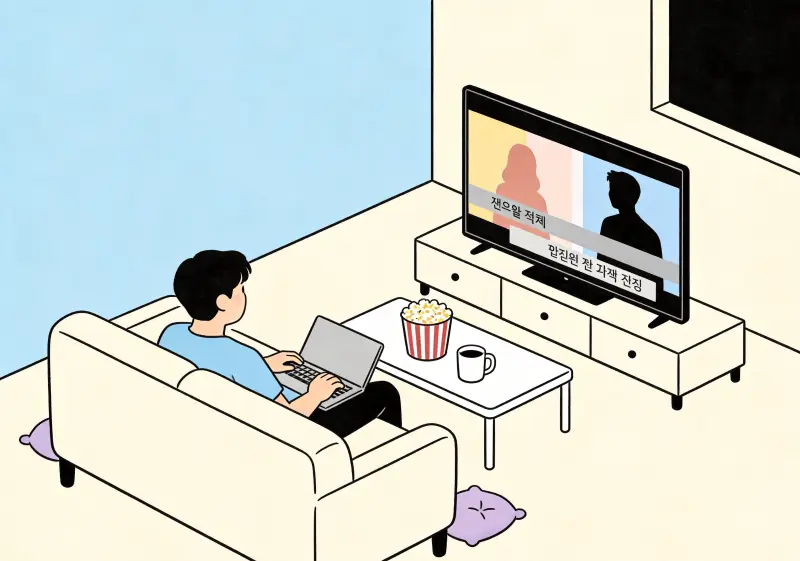
Subtitle strategy: first viewing with English subtitles for plot, second viewing of your chosen scene with Korean subtitles. The Korean-subtitle pass is where mining happens.
2. Mine Three Lines per Episode, Not Thirty
The mistake almost everyone makes: writing down thirty phrases per episode and remembering none of them. Flip the ratio — three lines per episode, maximum, and a line earns a spot in your notes only if it passes four filters:
- Short — something your mouth can say at full speed, roughly one breath
- High-frequency — a phrase that would come up in real life this week
- Personally usable — fits situations you actually encounter
- Clean — no heavy slang, no poetic inversion, no character quirk
The science: Craik and Lockhart's Depth of Processing theory (1972) demonstrated that the more deeply a piece of information is processed, the more connections it forms with existing knowledge, and the more durably it is stored. A line you chose yourself, from a scene you felt something about, is encoded far more deeply than the same line copied from a phrasebook.
How HelloTalk helps: when you are unsure whether a line is something a real person would say, post it in Moments and ask. Native Korean speakers will tell you within hours whether it sounds natural, dated, or drama-theatrical — the kind of judgment no dictionary provides.
3. Shadow Until Your Mouth Knows the Line
Reading a line and nodding is not practice. Shadowing is: saying the line out loud along with the audio, then without it. For each mined line:
- Listen to it three to five times while reading the Korean transcript.
- Say it with the audio, matching the rhythm and syllable timing — Korean rhythm lives in the beat of the sentence, not just the vowels.
- Say it without the audio at full speed.
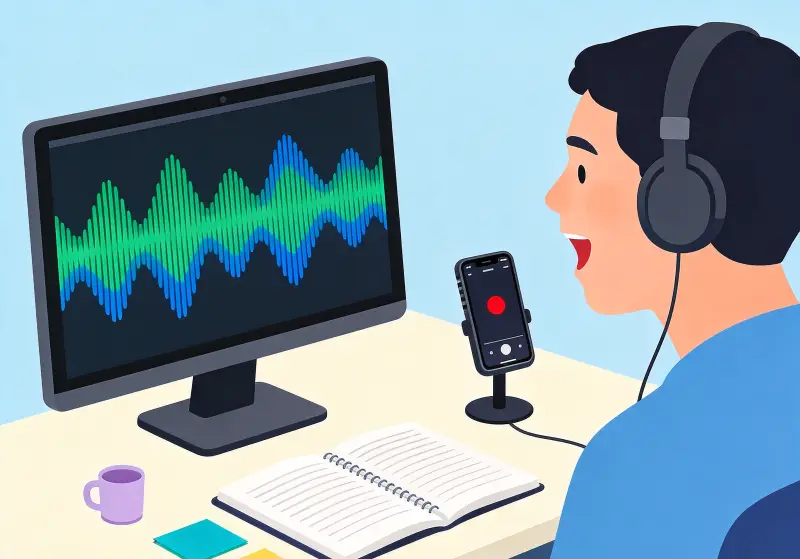
- Record yourself, play it back against the original, and note the gap.
You will hate hearing your own recording. Do it anyway — it is the only way to hear the errors that are invisible from the inside. Two to three passes per line across different days is spaced repetition doing its quiet work.
How HelloTalk helps: once a line is solid, message it to a Korean language partner instead of rehearsing it silently. A tap gives your partner transliteration and translation to check they understood you, and the built-in correction tool lets them mark one word and suggest the natural alternative — so the fix lands as a quiet annotation on your sentence, not an interruption of the conversation.
4. Say the Line to a Real Person Within 24 Hours
This is the habit that separates fans who eventually speak Korean from fans with a large but silent vocabulary.
The science: Hermann Ebbinghaus's Forgetting Curve (1885) remains one of the most replicated findings in memory research. Without use or review, newly learned information decays fast — roughly half of it gone within a day. A mined line that is not used within 24 hours will not survive the week. Used once, with a real person, it has a chance of becoming yours.
Three doors, ordered from least to most intimidating, all inside HelloTalk:
- Post in Moments. Share the line or the scene it came from and ask whether people really say this. It is writing, not speaking, and it is the lowest-pressure way to get native judgment.
- Message a language partner. Find a Korean speaker learning your language and work the line into a real exchange — text first, voice messages when you are braver.
- Join a Voiceroom. Live group voice chats where learners and native speakers talk about everyday topics, closer to drama-and-variety speed than any classroom audio, and built for imperfect speakers.
Your move tonight: open HelloTalk, set your target language to Korean, and post one mined line in Moments with the question "is this natural?" That single post is the whole loop, compressed.
What K-Pop Lyrics Are Actually Good For
Lyrics are a fantastic tool aimed at the wrong target when you use them for grammar. Sung Korean bends the language for meter: word order shifts, particles drop, vowels stretch. Use lyrics for what they are actually good at:
- Rhythm and linking. Rap and sung Korean expose how sounds connect and blur between syllables — exactly what your ear needs for fast conversation.
- Pronunciation reps you will actually do. You will repeat a hook you love fifty times without noticing. That is fifty pronunciation reps no flashcard can compete with.
- A bridge to conversation. Once you can sing a line cleanly, ask a Korean partner how you would say the same idea in normal speech. That contrast — poetic versus conversational — teaches register faster than any explanation.
The rule: one hook line per song, shadowed until clean, then one question to a native speaker about the everyday version. K-pop is fuel in this routine, not the syllabus.
Your 30-Minute Daily Watch-to-Speak Plan
| Time | Block | What you do | Where |
|---|---|---|---|
| 10 min | Input | Watch one scene with Korean subtitles, mine up to three lines through the four filters | Anywhere |
| 10 min | Output | Shadow each line: with audio, without audio, recorded and compared | Your desk |
| 10 min | Conversation | One Moments post, or messages with a Korean partner — use at least one mined line | HelloTalk |
Once a week, swap the conversation block for a longer session: 20 minutes in a Korean Voiceroom, listening and speaking at real speed. That weekly live session is where the first three blocks cash out.
Run it for a month and the structure matters more than the volume: 30 focused minutes with output and feedback beats three hours of passive binging, because only the first one gives your brain a reason to keep what it learned.
FAQ
Can I learn Korean just by watching K-dramas?
No. Watching builds listening and vocabulary, which is necessary but not sufficient — speaking requires producing the language and getting corrected. Use dramas as the input layer of the loop, not as the whole system.
Do I need to learn Hangul first?
Yes, and it is less work than people fear: most learners cover the alphabet in a weekend or two. After that, every Korean subtitle you read is reading practice, and you stop depending on romanizations that misrepresent the sounds.
How long until I can hold a basic conversation?
There is no honest fixed number — it depends on your hours and how much you actually talk. What is certain: a structured 30-minute routine with weekly live practice gets you to simple exchanges noticeably faster than more watching, because it trains the exact skill conversation requires.
Dramas or variety shows — which is better for learning?
Dramas for beginners: scripted, predictable, plot-repeated vocabulary. Variety shows once you can follow dramas comfortably, because the speech is unscripted and closer to real conversation speed.
Is the Korean in K-pop the same as everyday Korean?
No. Lyrics are a sung register — compressed, reordered, particle-light. Use them for pronunciation and motivation; get your sentence patterns from drama dialogue and native speakers.