
Korean Numbers in Everyday Plans: Tell the Time and Count What You Need
Published on

If you already know Korean numbers but still say the wrong time or count, you may be using the wrong number system for that slot. In an ordinary 12-hour clock sentence, the hour takes native Korean numbers and the minute takes Sino-Korean numbers, and a similar swap can trip up small object or person counts like books or people. A direct way to check whether your message landed is to send it to a partner on HelloTalk and ask which time or quantity they understood, before you show the numerals.
Why memorizing numbers doesn't mean you can tell time or count things correctly
If you learned the native numbers (하나, 둘, 셋) and the Sino-Korean numbers (일, 이, 삼) as two separate vocabulary lists, a list that only contains the numbers themselves won't tell you which one belongs in a real sentence, so you end up guessing when you actually need to say a time or a quantity.
Two number systems, one sentence
Korean uses native numbers for the hour and Sino-Korean numbers for the minute within the same clock-time sentence. The two number families look and sound completely different, so it's easy to mix them up mid-sentence. If you learned writing and reading through Hangul drills first, this is one of the practical gaps described in After Hangul: The Gap in Korean Resources Nobody Warns Beginners About, where knowing the alphabet doesn't yet mean you can produce a working sentence.
Where the confusion usually starts
Checking the number rules themselves against a resource like effective resources for learning Korean fast is one step; applying those rules to a concrete message like the one in this article is the next one.
Native Korean numbers for hours, Sino-Korean numbers for minutes
Once you know which system goes where, telling time becomes a matter of filling two slots correctly instead of guessing. The next distinction worth locking in before you build full sentences is what the hour marker itself is doing.
Clock hour (시) is not duration (시간)
시 marks a specific clock hour, while 시간 marks a duration in hours, so swapping them changes what the sentence is actually saying. 세 시 means three o'clock; 세 시간 means three hours. This distinction matters the moment you start combining a time with a plan, since mixing up a point in time with a length of time changes the whole message.
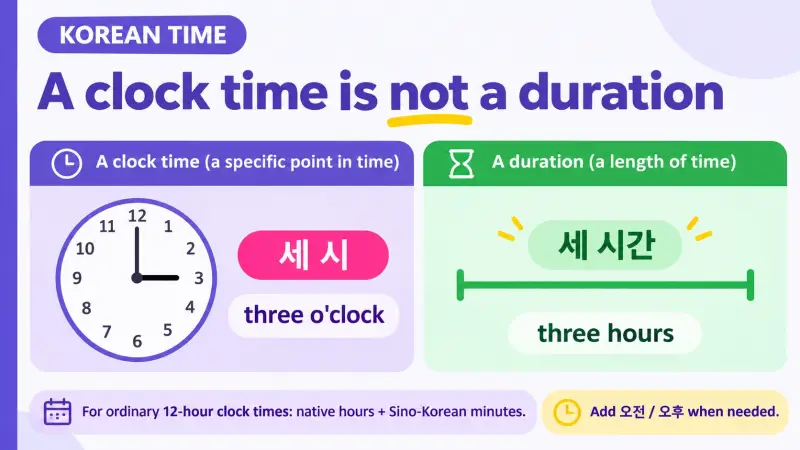
The table below shows how the two number systems split across an ordinary 12-hour clock-time sentence, breaking the hour and minute parts into their own columns so the pattern is easy to reuse.
| Time | Hour part (native) | Minute part (Sino-Korean) | Full phrase |
|---|---|---|---|
| 2:30 | 두 시 | 삼십 분 | 두 시 삼십 분 |
| 3:10 | 세 시 | 십 분 | 세 시 십 분 |
| 12:50 | 열두 시 | 오십 분 | 열두 시 오십 분 |
| 4:15 (polite) | 네 시 | 십오 분 | 네 시 십오 분이에요 |
| 3:42 (polite) | 세 시 | 사십이 분 | 세 시 사십이 분이에요 |
Read the table by column, not by row order: in an ordinary 12-hour clock sentence, the hour part comes from the native list and the minute part comes from the Sino-Korean list. Since this is a 12-hour format, add 오전 (a.m., before noon) or 오후 (p.m., after noon) when scheduling an appointment and the time of day isn't already clear. The short native forms 한, 두, 세, and 네 that appear before 시 here will come back in the next section, because they do the same job in front of several counters.
Matching counters like 개, 권, and 명 to the right number form
Telling time solves the hour-and-minute slot. Counting objects or people adds a third piece: a counter word that tells you which number form to use and how to attach it to the noun.
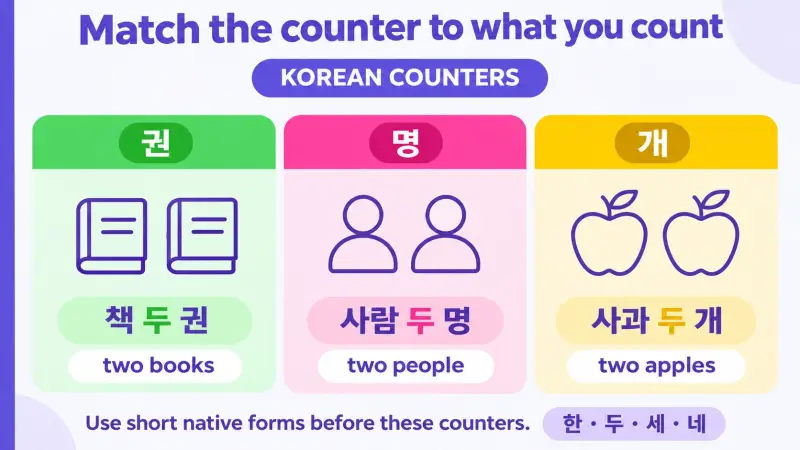
Short forms before a counter
Common counters like 권 for books and 명 for people pair with the short native number forms 한, 두, 세, and 네, not with their full dictionary forms. 하나 shortens to 한, 둘 to 두, 셋 to 세, 넷 to 네, and 스물 shortens to 스무 before a counter. This is the same shortening pattern you just saw in front of 시, so you are not learning a new rule, only reapplying it to a different word category.
The table below pairs a few common counters with checked or directly comparable examples, so you can see the noun-number-counter order in practice.
| Counter | Typical items | Example | Meaning |
|---|---|---|---|
| 권 | books, bound volumes | 책 두 권 / 책 네 권 | two books / four books |
| 명 | people | 사람 두 명 / 사람 세 명 | two people / three people |
| 개 | general countable objects | 사과 두 개 | two apples |
Use 명 for people and 권 for books in the examples above; 개 is a separate counter for general countable objects, such as apples, and isn't the counter to reach for when you mean a person or a book.
Building and checking real time-and-count messages with a partner on HelloTalk
The two tables above help you build a sentence that follows the number rules. Whether it actually communicates the time and quantity you meant is a separate question, and asking a partner what they understood adds real evidence of what came through.
Drafting one message that carries both a time and a count
Try combining both slots in a single short message, for example: 세 시 십오 분에 만나요. 책 두 권 가져갈게요, meaning "Let's meet at 3:15. I'll bring two books." This is a practice example to adapt with your own real time and items, not a record of an actual exchange.
Asking what they understood, not just whether it's correct
Send that message on HelloTalk to a willing Korean-speaking partner, and ask them to tell you back the time and the quantity in their own words before you confirm the numerals. For instance, a partner might reply with something like "3시 15분에 책 2권 가져오는 거 맞죠?" ("You're bringing two books at 3:15, right?"), which would show they picked up both numbers correctly. A reply like that confirms the message worked in that one exchange, not that every similar sentence you write will land the same way.
Reusing a confirmed phrase
Once a time-and-count phrase has been understood once, keep it and swap in a new time or a new item for your next real message instead of starting from scratch. Pairing a quick grammar check with this kind of real-message check is close to the approach described in Which Two Korean Methods Pair Well, and Which Ones Overlap?, where a reference source handles the rule and a partner handles whether your specific sentence actually communicates.
FAQ
Does every Korean number situation split into native versus Sino-Korean the same way shown here? No. This split applies to ordinary clock time and the small object or person counts covered in this article; other contexts, like dates or large numbers, follow different conventions not covered here.
Why do 시 and 시간 look so similar but mean different things? 시 marks a specific point on the clock, like three o'clock, while 시간 marks a length of time, like three hours; using the wrong one changes whether you're naming a moment or a duration.
Do all counters take the short native number forms? The short forms 한, 두, 세, and 네 are used before 시, 권, 명, and 개 in the examples here. 스무 is the short form for counts like 20 items, not a form you'd use with 시 in the ordinary 12-hour clock; always check a specific counter before assuming a shortening applies.
What if my HelloTalk partner doesn't reply or misunderstands my message? There's no guarantee of a reply or a particular response time; if the time or count seems misunderstood, try resending with a clearer counter or splitting the time and the count into two shorter messages.
Do I need to learn every Korean counter before trying this? No. Start with a few high-frequency counters relevant to what you actually talk about, such as 권, 명, and 개, and add others as your messages require them.
Does a correct guess from one partner prove my sentence is grammatically right? It confirms that particular message was understood in that exchange, not that the grammar is universally correct; checking the same sentence against a dictionary or course material is still worth doing.
Do I need to say 오전 or 오후 every time I mention an hour? Only when the time of day isn't already clear from context, such as when proposing a specific appointment; add 오전 (a.m., before noon) or 오후 (p.m., after noon) before the hour so your partner doesn't have to guess.
If you want to test whether your own time-and-count sentence actually communicates, try sending it to a partner on HelloTalk today.