
Japanese Kanji Readings: Learn the Word, Not Every Reading at Once
Published on

When you already know which word you mean, you can look up its specific reading rather than guessing from a reading you learned for the same kanji elsewhere. The kanji 大 appears in 大人, 大学, and 大きい, but no single reading you memorized for 大 covers all three words.
A dictionary or vocabulary entry confirms the reading for each exact word, and audio on that entry can help you confirm how it sounds. Once you want to know whether a real listener understands the word the way you intended, a willing partner on HelloTalk is useful for that specific check.
Why One Kanji Can Have Several Readings Depending on the Word
Japanese textbooks usually introduce on'yomi and kun'yomi early, but the label matters less than the practical fact behind it: the same kanji slots into different words with different pronunciations, and the character alone does not tell you which one applies. 大 appears in 大人, 大学, and 大きい, and each word carries its own reading rather than one sound for 大 reused everywhere.
A single kanji's reading is decided by the word it appears in, not by a fixed sound attached to the character in isolation. A flashcard that just says 大 equals たい or だい can look correct on its own, and still fail the moment that same 大 shows up in 大人, where the reading is neither one.
Kanji and kana carry different jobs in a Japanese sentence, a distinction covered in more depth in Three Writing Systems, Three Jobs: How Japanese Resources Divide the Work. The reading problem here sits one level below that: it is about which word you are reading, not which script it is written in.
That distinction, between reading a character and reading a word, decides what your app's reading quiz is actually testing.
What Your App's Reading Quiz Is Actually Testing
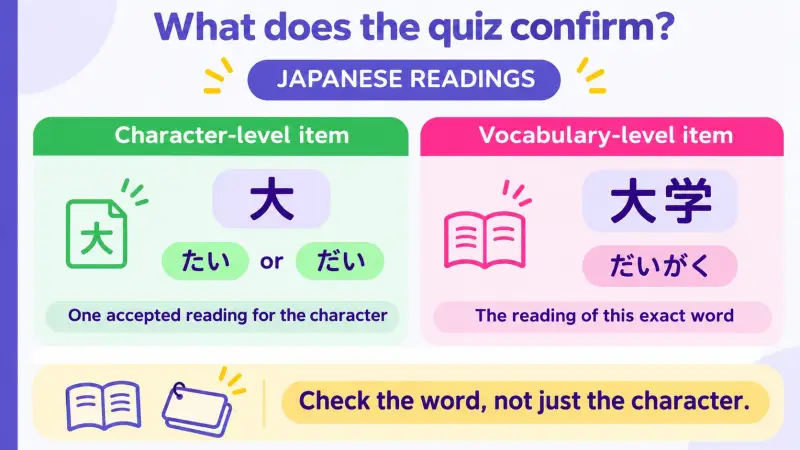
Spaced repetition apps like WaniKani teach kanji and vocabulary as separate item types, which is exactly where word versus character confusion starts. A kanji-level item tests one accepted reading for the character alone, while a vocabulary-level item tests the reading of one specific word. Mixing up which type you are looking at makes it easy to misjudge what you actually know.
The table below separates what each quiz type confirms, based on how WaniKani's own kanji and vocabulary pages describe their reading checks.
| Quiz type | What a correct answer confirms | What it does not confirm |
|---|---|---|
| Kanji-level item (for example, 大 on its own) | Recognition of one accepted reading for that character | Which reading the character takes inside a specific word |
| Vocabulary-level item (for example, 大学) | The dictionary reading for that exact word | Whether you pronounced the word clearly in a live conversation |
WaniKani's own Multiple Readings explanation uses 大 directly: a kanji-level review for 大 accepts either たい or だい as correct, not both combined into one response. A kanji-level quiz that accepts either たい or だい for 大 confirms one acceptable reading for that character, not a single combined pronunciation. That is a narrower claim than confirming how 大 is read inside 大人, 大学, or 大きい.
The vocabulary-level page for a word like 大学 lists its own accepted reading separately, with audio and example sentences meant for context. The audio is available on that page, and the example sentences are not guaranteed to match any particular reader's level, so they work better as reference material than as a built-in speaking check. If you are still deciding between WaniKani, Genki, and Duolingo for this kind of vocabulary work, that comparison is laid out separately in Genki vs WaniKani vs Duolingo for Japanese: Which Does What.
Three Words That Show How the Same Kanji Changes Reading
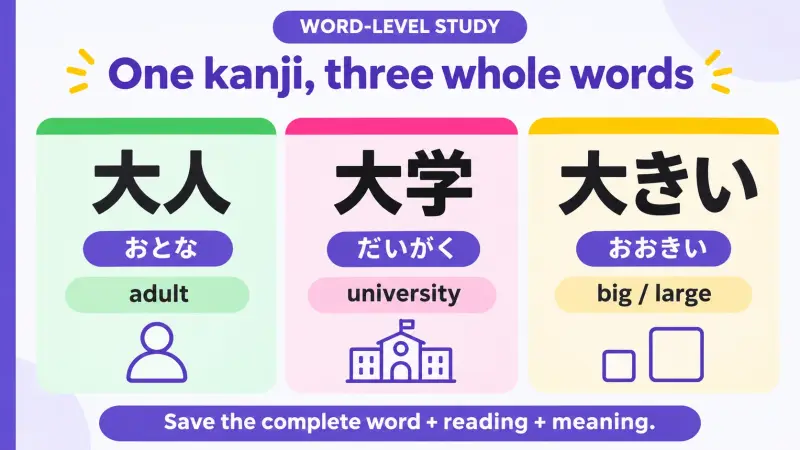
大 is a useful test case because it shows up in common words at every level, and because no single reading you might have learned for 大 applies to all three of these words at once. The table below uses the same character in three different words, each needing its own study item since the reading belongs to the whole word.
| Word | Reading | Meaning | Where the reading comes from |
|---|---|---|---|
| 大人 | おとな | adult | Irregular reading for the whole word, not built from 大 or 人 separately |
| 大学 | だいがく | university | On'yomi compound reading, だい for 大 combined with がく for 学 |
| 大きい | おおきい | big / large | Kun'yomi reading おお for 大, plus the okurigana きい |
大 produces three different whole-word readings here, おとな in 大人, だいがく in 大学, and おおきい in 大きい, and knowing one does not hand you the other two. 大人 carries an irregular reading that has to be learned as a whole word. 大学 follows the more common pattern of combining on'yomi readings inside a compound, and 大きい keeps the kun'yomi reading おお but needs the okurigana きい written out, since おおき alone is not a complete word. Patterns like compounds leaning on on'yomi are useful hints, but they do not replace checking the specific word.
Seeing these three side by side points to a study habit: since the reading belongs to the word, the study item should be built around the word too.
Building a Study Item Around the Whole Word, Not the Character
Writing a study item as a whole word, complete with its own reading and meaning, addresses what single-character flashcards tend to miss. Once you can tell a kanji-level prompt apart from a word-level one, the practical steps are: confirm the reading at the word level, write the item as a complete word, and attach one original sentence that ties the word to something true about your day.
If you are still deciding which overall app or textbook setup fits your routine, that wider decision is covered separately in Japanese Learning Tools Compared: Apps, Textbooks, and SRS; this section only covers turning whichever tool you already use into word-level items.
Confirm the reading at the word level
Look the word up on a vocabulary page or dictionary entry, not just the kanji entry, and note the reading listed for that exact word. For 大人, that entry lists おとな as the reading and adult as the meaning, separate from whatever the kanji-only entry says about 大 or 人.
Write the item as the complete word
Your study item becomes 大人 (おとな) = adult, not 大 = たい/だい with a note to figure out the rest later. Do the same for 大学 (だいがく) = university and 大きい (おおきい) = big / large, keeping the okurigana attached since おおき alone is not usable on its own.
Attach one original sentence
Write one short sentence for each word so the reading sits inside real use, not just a glossary pair. For example: 私はもう大人です (I am already an adult), 来年、大学に入ります (Next year, I will enter university), and この犬は大きいです (This dog is big).
A dictionary reading and a sentence you wrote yourself confirm how the word should read. What they do not confirm is whether another person understands the word the way you intended when you actually say or send it.
Checking Which Word Your Partner Actually Heard
Once you have a word-level item and an original sentence from the previous section, record it as a voice message and send it to a willing exchange partner on HelloTalk, since this section is about what a listener actually hears, not just what they can read. Attach one specific content question so the partner has something concrete to respond to, rather than asking them to grade the recording.
As a suggested exercise, not a real exchange, if your partner has already mentioned having a dog, you could send the voice message この犬は大きいです (This dog is big) and ask あなたの犬も大きいですか? (Is your dog big too?). A reply that engages with size, such as はい、大きいです (Yes, it's big) or いいえ、小さいです (No, it's small), suggests the partner understood 大きい as intended, even without repeating the word back.
If a reply does not address size at all, a narrower follow-up such as 今のメッセージで、犬の大きさについて何と言ったと思いましたか? (What do you think I said about the dog's size in that message?) asks directly about the word heard, rather than about its meaning.
A reading confirmed in a dictionary still benefits from a quick check with a willing listener, since a dictionary entry cannot tell you whether a specific spoken sentence was clear in actual use. For the standard, published reading of a word, a reliable vocabulary entry remains the source to check; a partner's reply tells you something different, what they understood from this specific sentence, not a verdict on the dictionary form.
Keep the feedback request narrow: ask about the one word or sentence you are testing, not a full correction of everything you said, so the reply stays easy to act on. If the word worked, save the sentence and the reply so you can reuse that pairing next time 大人, 大学, or 大きい comes up.
FAQ
Does learning one reading of a kanji help me read every word that contains it?
Not reliably. A kanji's reading depends on the specific word around it, so a reading you learned for one word, like だい in 大学, does not automatically transfer to a different word such as 大人 or 大きい.
What's the real difference between a kanji-level quiz and a vocabulary-level quiz?
A kanji-level quiz checks one accepted reading for the character by itself, while a vocabulary-level quiz checks the reading of one specific word. Mixing the two up is an easy way to think you know a word's reading when you have only confirmed the character's.
Why does WaniKani accept either たい or だい for 大?
Because 大 has more than one accepted reading at the character level, and the quiz is asking for one of them, not both combined into a single answer. Which reading actually applies still depends on the word it appears in.
Do I need to memorize okurigana as part of the reading?
For words like 大きい, yes. The kun'yomi reading おお only becomes a complete, usable word once the okurigana きい is attached, so leaving it off turns the item into an incomplete fragment rather than a real word.
Can I just ask a language partner for a word's reading instead of checking a dictionary?
A dictionary or vocabulary entry is where you confirm a word's standard, published reading. A partner is most useful afterward, for telling you what they understood when you said or wrote the word in a sentence.
Is on'yomi always used in compound words and kun'yomi always used alone?
Not as a strict rule. 大学 follows the common pattern of two on'yomi readings combined in a compound, but 大人 is an irregular reading that does not follow either the on'yomi or kun'yomi pattern in a predictable way, which is why it has to be learned as its own word.
What should I actually send a partner on HelloTalk if I only want to check one word?
Send the specific sentence that contains the word, ideally as voice if you want to check how it sounds, and ask one narrow question about that sentence rather than requesting a general correction, so the reply you get back is focused on the one thing you are checking.
How many example words should I study before I feel confident with a kanji like 大?
There is no fixed number that guarantees confidence, but working through a small set of real words, such as the three covered here, is more useful than trying to memorize every theoretical reading of the character at once.
If you already have a word confirmed and a sentence ready, open HelloTalk and send it to a partner who is willing to tell you what they actually understood.