
Turn a Written Notice Into Clear Spoken Instructions
Published on

You need a real listener's response here when you want to check whether your spoken explanation actually gets someone to the right action, not just whether you understood the text. Reading a notice and picking out a date is one skill. Turning it into spoken instructions that lead a specific listener to the correct next step is a different, harder task, and it is easy to overestimate how ready you are for it.
HelloTalk gives you a place to explain a notice like this to a partner and hear what they plan to do next, which gives you concrete evidence about whether your explanation worked for that exchange.
Why Reading a Notice Is Not the Same as Explaining It
Understanding every sentence in a notice does not guarantee you can tell someone else what they specifically need to do. Reading comprehension asks you to find facts in a text. Explaining asks you to select which of those facts matter for one listener's situation, put them in a usable order, and leave the rest out.
This gap sits close to the one described in I Can Read a Language but Cannot Speak It: What to Practice Next. The difference here is that the missing skill is not producing sentences in general. It is choosing which facts from a shared text matter for a particular person, and dropping the ones that do not.
The clearest way to see this is to work through one notice with two different listeners in mind, since the same sentences will matter to one and not the other.
Picking Out the Information One Listener Actually Needs
Here is a short practice notice, written for this exercise, along with two listener goals that pull very different information out of the same text.
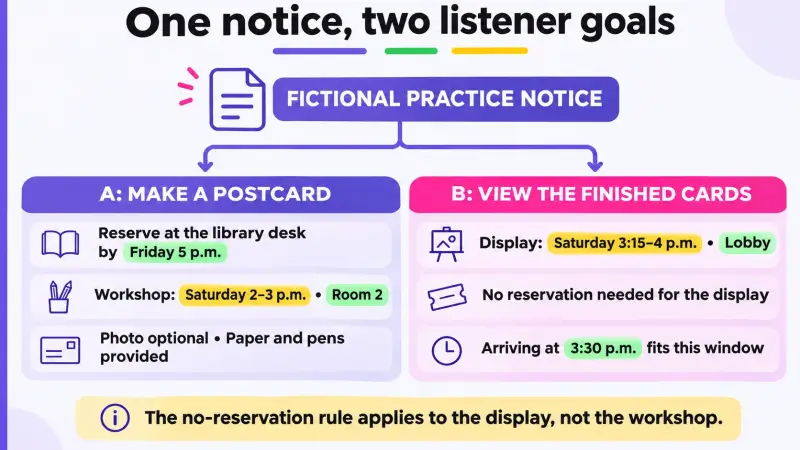
Fictional practice notice: "Saturday postcard workshop: Make a postcard in Room 2 from 2 to 3 p.m. To join the workshop, reserve a place at the library desk by 5 p.m. on Friday. Bring a photo if you want to use one; paper and pens are provided. If you only want to see the finished postcards, visit the lobby between 3:15 and 4 p.m. No reservation is needed for the display."
Two listener goals from the same notice
Listener A says: "I want to make a card. I have a photo, but I have not reserved a place." Listener B says: "I cannot arrive before 3:30 p.m. I only want to see the finished cards."
| Listener | Essential information from the notice | Not needed for this goal |
|---|---|---|
| A: wants to make a card, has a photo, no reservation yet | Reserve at the library desk by Friday 5 p.m.; workshop is Saturday 2-3 p.m. in Room 2; a photo is optional, paper and pens are provided | The display hours and the rule that the display needs no reservation |
| B: cannot arrive before 3:30 p.m., only wants to see finished cards | Finished postcards are on display in the lobby from 3:15 to 4 p.m.; no reservation is needed for the display; 3:30 p.m. falls inside that window | The Friday reservation deadline; bringing a photo; paper and pens |
The same notice produces two different sets of essential information once you filter it through what each listener is actually trying to do. Listener A's next step depends on a deadline that does not exist for Listener B, and Listener B's next step depends on a time window Listener A never needs to check.
Leaving Out Details That Don't Apply to Their Goal
Once you have sorted the information by listener, the harder part is actually leaving things out instead of repeating the whole notice to be safe. For Listener A, the display hours and the "no reservation needed" line do not apply, because that line only covers viewing, not making a card.
This is where a common mixing error shows up: a listener hears "no reservation needed" and applies it to the workshop instead of the display. If that happens, the fix is to point back to the condition in the notice, that the no-reservation rule is specifically "if you only want to see the finished postcards," not a general rule for the whole event.
For Listener B, the opposite problem can occur. They do not need to hear about reserving a place or bringing a photo, since none of that affects someone who is only viewing the display. Dropping irrelevant conditions is part of the task, not a shortcut that skips something important.
Explaining the Steps and Conditions Out Loud
Once you know what each listener needs, the next step is saying it in a usable spoken order rather than reading the notice aloud. A spoken explanation usually works better when it leads with the action the listener has to take, then adds the supporting condition.
A possible script for Listener A
"You need to reserve a place at the library desk before Friday at 5 p.m. The workshop itself is Saturday from 2 to 3 p.m. in Room 2. Bringing a photo is optional, and paper and pens are provided either way."
A possible script for Listener B
"The finished postcards are on display in the lobby from 3:15 to 4 p.m. on Saturday. You don't need to reserve anything to see them, since that reservation rule only applies to the workshop itself."
These scripts are short enough to say as a single voice message. Record one of them as a voice message on HelloTalk to a partner who agrees to play the role of Listener A or B, and ask them directly what they would do based on what you just said. That response is what tells you whether your explanation actually carried the right condition, not whether it sounded fluent.
If you want a model for turning notice sentences into spoken phrases rather than written ones, How to Turn Sentences You Read Into Phrases You Can Say covers that conversion step in more detail.
Checking What the Listener Plans to Do Next
One useful check here is not whether the listener can repeat the notice back to you, but whether their stated next step matches the condition that applies to their goal. Asking "what will you do now" gives you a concrete answer you can compare against the notice, instead of a vague "got it" that does not tell you anything.
| Listener | A possible reply | What it tells you |
|---|---|---|
| A | "I'll reserve a place at the library desk before Friday at 5 p.m., and since paper and pens are provided, I don't need to bring my photo unless I want to." | The reply names the exact reservation deadline and shows the photo is optional rather than required |
| A (needs a correction) | "I'll just show up Saturday at 2, no reservation needed." | The listener mixed up the display's no-reservation rule with the workshop; point back to the Friday deadline |
| B | "I'll come at 3:30 and just walk into the lobby, no need to book anything." | The display window and the no-reservation condition both landed correctly |
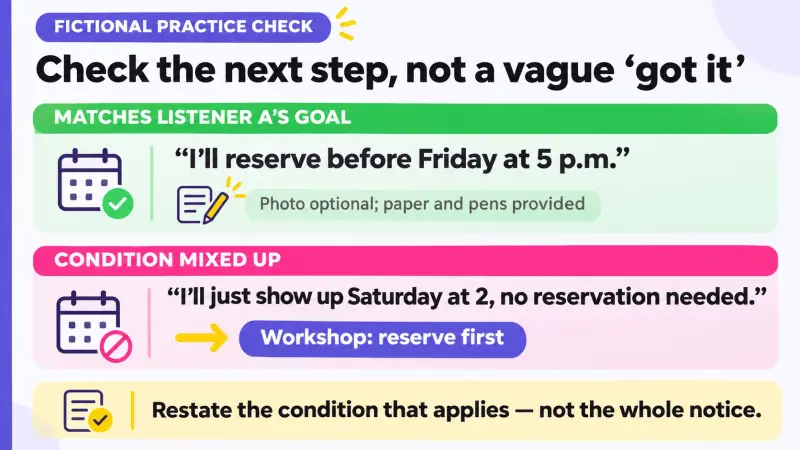
If a reply shows a mixed-up condition, the fix is narrow: restate the one sentence that applies, not the whole notice again. This kind of check connects back to a broader point about communication goals rather than word-perfect recall, which is covered in Why Effective Communication Is the Real Goal of Language Learning (And How to Actually Get There). When a listener takes the right action, that is evidence your explanation worked for that exchange, even if a few words along the way were imperfect.
FAQ
What actually counts as success in this exercise? Success is the listener stating a next step that matches the condition for their specific goal, not reciting the notice back to you word for word.
Do I need a fluent partner for this to work? You need a willing partner who can understand your explanation well enough to state what they would do, which does not require advanced fluency on either side.
What if my partner doesn't respond, or responds much later? A delayed or missing reply just means you don't have a check for that attempt yet; try a different partner or a different time rather than treating silence as a verdict on your explanation.
Can I use a real notice from my life instead of the example one? Yes, as long as it does not contain private or sensitive information you would not want to share, and as long as you can define at least two different listener goals for it.
How is this different from general reading or phrase practice? Reading and phrase practice work on understanding or producing sentences; this task is specifically about selecting and sequencing facts for one listener's goal and checking their resulting action.
Does this only work for simple notices like the postcard example? The same selecting-and-checking pattern applies to longer or more complex notices, though you may need to be more selective about which details to include as the source text grows, as long as every condition that changes the listener's action stays in.
What if the listener's reply surprises me, like a third option I didn't plan for? A surprising reply does not automatically mean your explanation was unclear. Ask what goal or condition the listener is using, compare it to the notice, and clarify only the specific point that needs it.
If you want to try this with your own notice, open a conversation on HelloTalk and explain it to a partner who is willing to tell you what they would do next.