Spanish Courses vs Language Exchange: What Gets You to Conversational Faster?

There are two broad ways to attack Spanish. One is a course: a structured path of lessons that teaches you the language step by step. The other is language exchange: trading practice with a native speaker who is learning your language. Both work. But they are fast at different things, and confusing the two is why a lot of people study for a year and still freeze when a real Spanish speaker talks to them.
Here is the honest answer up front. Courses build the raw material of Spanish, while language exchange trains the skill of using it live, so the fastest route to conversational is not choosing one but sequencing them. Let's unpack what each does and when.
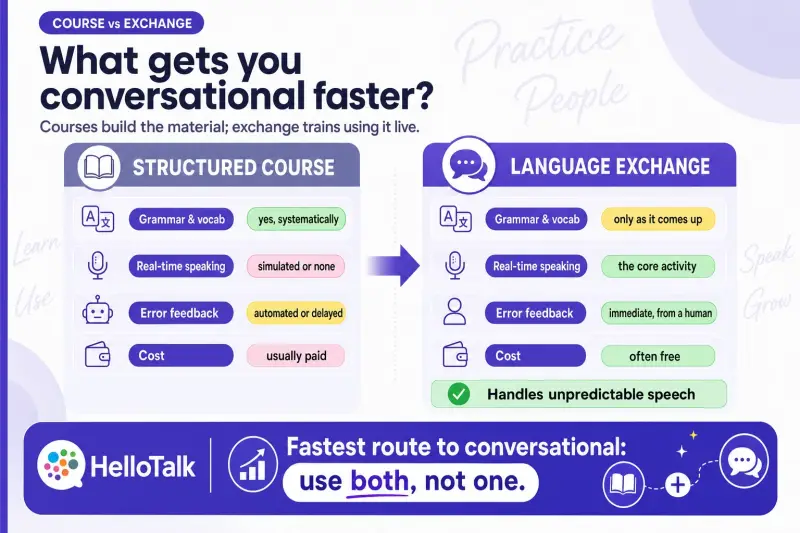
What each path is actually good at
| Dimension | Structured course | Language exchange |
|---|---|---|
| Teaches grammar and vocabulary | Yes, systematically | Only as it comes up |
| Real-time speaking practice | Simulated or none | Core of the activity |
| Feedback on your errors | Automated or delayed | Immediate, from a human |
| Handling unpredictable speech | Weak | Its whole purpose |
| Cultural and slang nuance | Textbook version | The living version |
| Cost | Usually paid | Often free |
| Best stage to lean on it | First weeks | From week one, then heavily after |
Why courses feel fast but stall
Courses are satisfying because progress is visible. You finish a unit, a bar fills up, you unlock the next thing. For the first few weeks, that structure is genuinely useful: you need a base of high-frequency words and a rough sense of how sentences are built.
The problem shows up later. A course can only teach you Spanish that it has scripted in advance, so it cannot prepare you for the one thing real conversation is made of, which is unpredictability. A native speaker will use slang, drop pronouns, speak fast and ask you something the course never covered. Learners who live inside courses often have a large passive vocabulary and almost no ability to produce it under pressure. That gap is exactly what our piece on how to practice Spanish speaking with daily methods is built to close.
Why language exchange gets you conversational
Language exchange is not about learning new grammar. It is about using grammar you already half-know, with a real person, in real time. That pressure is uncomfortable, and it is exactly why it works so fast. You discover which words you actually reach for, where you hesitate, and what you keep getting wrong, and a native speaker fixes it on the spot.
The single biggest predictor of becoming conversational quickly is total minutes spent producing spontaneous speech with feedback, and language exchange maximizes exactly that. This is why it beats courses on the specific goal of talking.
The catch: pure language exchange with zero base is rough. If you know ten words, a live voice call is overwhelming. That is why sequencing matters, and why the best exchange tools soften the entry, which we cover next.
Consider a concrete example. Two beginners each study 40 hours. Emma spends all 40 on a course and can recite verb conjugations perfectly, but when a Spanish speaker greets her, she blanks. David spends 25 hours on a course and 15 talking to real partners. He knows less grammar on paper, but he can order food, ask directions and recover when he does not understand. On the one metric that matters here, being able to hold a conversation, David is far ahead. The difference was not talent or study time. It was where the hours went.
HelloTalk: language exchange with the friction removed
HelloTalk is built around real Spanish speakers, but it is designed so beginners can start before they feel ready.
-
Chat-based learning lets you begin in text, with in-line translation, transcription and read-aloud, so a message you could never say out loud yet becomes doable in writing.
-
Moments is a public feed where you post short Spanish and several native speakers correct it, giving you the feedback loop a course cannot.
-
Voicerooms and Livestreams let you join a 24-hour voice room as a listener first, then speak when you are ready, easing you from text into live audio.
-
AI learning tools score your pronunciation with specific notes and correct grammar in real time, so you get course-like feedback inside a real conversation.
With 70M+ registered users across 200+ countries and 260+ languages, and 90% of core features free, it lowers both the cost and the fear that usually stop people from starting exchange early. If you are curious how a first exchange actually flows, your first Spanish conversation breaks it down.
There is a second, quieter benefit. Because your partner is also learning your language, the relationship is balanced. You are not a paying student who feels guilty taking up someone's time; you are trading help. That balance makes people show up more often and stay longer, and consistency is what actually moves the needle. A partner you message three times a week for a month teaches you more than a perfect tutor you book once and never return to.
The sequence that is actually fastest
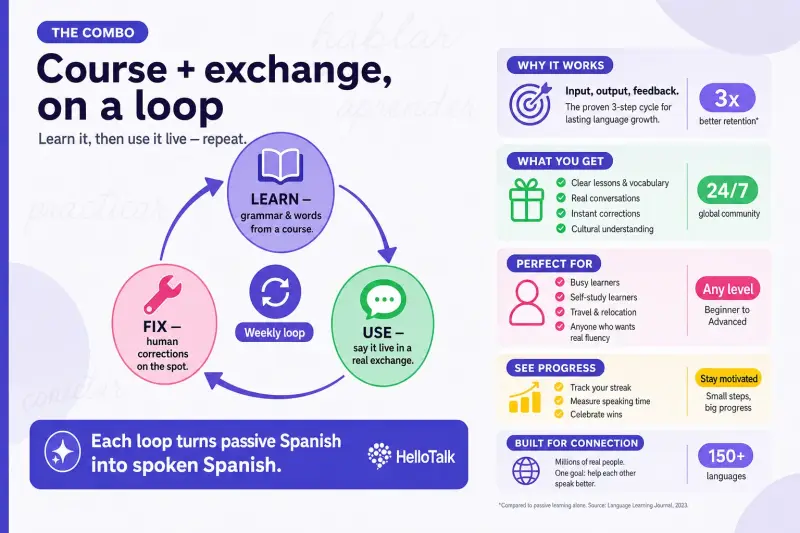
You do not have to pick a side. Here is the order that gets most people conversational quickest:
-
Weeks 1-2: Use a course or app for a base of the most common words and sentence patterns. Keep it short.
-
From week one, in parallel: Start text exchange with native speakers so you are producing Spanish immediately, not someday.
-
Weeks 2-4: Shift weight toward live voice as your comfort grows, using listener-mode voice rooms as a bridge.
-
Ongoing: Keep a course only as a reference for grammar you keep tripping on.
For the exact tools and daily actions across that first month, see the Spanish fast-start stack for your first 30 days. And if you are deciding which specific app to lead with, Pimsleur vs Babbel vs HelloTalk for Spanish and our best Spanish apps ranked by speed to first conversation both help.
Common mistakes when choosing between courses and exchange
-
Treating the course as the finish line. It is the warm-up, not the race.
-
Delaying exchange until you feel fluent. You never will. Start early and ugly.
-
Doing exchange with no base at all. A tiny foundation makes the first conversations survivable.
-
Only listening. Input matters, but conversational speed comes from output.
FAQ
Which is faster for becoming conversational, a course or language exchange? Language exchange, because conversational skill comes from spontaneous speaking with feedback, which courses rarely provide.
Do I still need a course at all? For the first weeks, a light course helps build a base. After that it becomes a reference more than a driver.
Is language exchange free? It can be. HelloTalk keeps 90% of core features free, and exchange is a mutual trade, so no tutoring fees.
What if I am too shy to speak? Start in text, then enter voice rooms as a listener before you talk. The ramp is gentle on purpose.
How is this different from a tutor? A tutor teaches you; an exchange partner practices with you and gets your help in return. Our language exchange guide explains the dynamic.
How soon can I be conversational? With a base plus regular real practice, many learners hold short conversations within weeks, then build from there.
Start the practice that actually counts
Courses give you the pieces. Conversation puts them to work. Start trading real Spanish with a native speaker today on HelloTalk at HelloTalk.