
One App, Multiple Languages: Courses, Profiles, and Conversation Limits

Yes, one account can usually carry more than one language, but courses, profile languages, and partner filters are separate settings that break in different ways. If you want a human reply in the language you just restarted, the HelloTalk fields worth checking are your profile learning languages and your own search filters. Adding a Spanish course on Monday does not change the fact that Friday's messages are still arriving in Japanese.
Compare Duolingo, Busuu, and HelloTalk by the Setting You Need
Three settings sit behind the question: the active course in a lesson app, the languages your profile says you teach and learn, and the filters you use when you search for partners. A yes to the first one does not settle the other two, so this page checks them separately.
The table sorts those settings across the three products using what each company's own documentation describes, not a walkthrough on a device. Read down a column for the product you already use, and across the row for the setting that is currently unclear.
| What you are trying to set | Duolingo | Busuu | HelloTalk |
|---|---|---|---|
| Add a second language | Duolingo's post describes adding another course to the same account from course selection | Busuu's help centre describes changing your course or the language you are learning | HelloTalk's FAQ says a VIP account can add two more teaching or learning languages in profile Language settings |
| What happens to earlier work | Removing a course permanently deletes that course's progress, per Duolingo's post | Busuu's help says earlier progress is still there when you return to that course | HelloTalk's FAQ frames learning languages as a profile setting, not as a record of lesson progress |
| How often you can change it | Described as a course selection action in the checked post | Described as a self-serve course change in the checked help article | HelloTalk's FAQ: VIP can change learning languages any time, non-VIP once every two days |
| How you look for people in that language | The checked post covers courses and streaks, not partner search | The checked article covers course switching, not partner search | HelloTalk's Advanced Search shows people matching the native and target language criteria you set, which follow your profile choices |
| What to confirm in your own account | Whether one shared streak is hiding a course you never open | Which exercise formats exist in each of your languages, which the checked help does not list | Which language and search changes your membership allows, since HelloTalk's FAQ puts VIP conditions on some |
Two of those rows are the ones this page takes apart next: what a switch does to work you already finished, and what a profile language actually describes. Both are easier to check before you change anything than after.
Course Switching and Saved Progress Are Separate Questions
Switching is a menu action. Keeping your finished work is a storage question. A help page that answers the first does not always answer the second, and the difference is easy to meet in the wrong order, while tidying a menu.
Removing a Duolingo course permanently deletes that course's progress, while Busuu's help centre describes earlier progress as still there when you return to a course you switched away from. Switching away and removing read as different decisions in those two documents, so make the destructive one deliberately rather than while clearing a menu.
Duolingo's own post says any lesson you complete counts toward the single overall streak, so a long streak does not show that both languages in your account were practised. The number can keep growing on one course while the other sits untouched, so a streak tells you a lesson was finished somewhere in the account, not which language it was in.
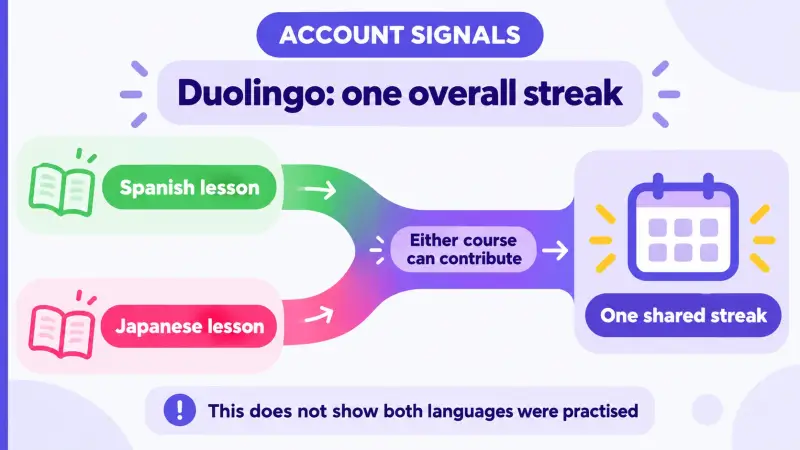
Evidence about one specific language has to come from somewhere else. On HelloTalk, send one sentence in the language you are worried about and ask a partner whether that sentence sounds natural to them, because their answer is about that sentence in a way a shared streak is not. It tells you how one reader took one line, not how strong the language is overall, and the message stays an invitation that may go unanswered.
On HelloTalk, Distinguish Learning Languages From Partner Filters
Profile languages and search filters sound like one setting and do different jobs. One describes what you are learning to anyone who opens your profile. The other narrows the list your own search returns, and HelloTalk's FAQ describes those search criteria as following your profile choices, so the two fields are worth checking separately rather than assuming a change in one either carries over or stays put.
HelloTalk's FAQ on adding a teaching or learning language says a VIP account can add two more teaching or learning languages in the profile Language settings. That setting states what you teach and what you are learning; HelloTalk's FAQ does not present it as a lesson-progress manager, so it will not track where you stopped in a course somewhere else.
HelloTalk's FAQ describes how often learning languages can change rather than how many you may hold: a VIP account can change learning languages at any time, and a non-VIP account can change once every two days. Frequency and capacity are separate numbers, and neither one is the same as the full list of languages the app supports.
HelloTalk's FAQ on searching for partners by language describes Advanced Search as showing people who match the native and target language criteria you set, with those criteria following your profile choices and some changes limited to VIP. So if the language you want is not among the criteria you can select, check what the search screen is currently offering you and what your membership allows there, rather than assuming one fixed order for changing the profile and changing the filter.
Once the Spanish criteria are selectable in your account, the rest is one message. On HelloTalk, send one line plus one narrow question, for example: "I am restarting Spanish after a year of Japanese. Does Llevo un año sin practicar español (I haven't practised Spanish for a year) sound natural to you, or would you say it differently?" You are asking a person because the reply can be about your sentence, in the situation you described.
That Spanish line is a written example to ask about, not wording a native speaker has already checked. A narrow question is also smaller to answer, not more likely to be answered.
If an answer does come back with different wording, keep it in your notes with the date and the situation, then open your next Spanish conversation on HelloTalk with that version so you can see how a second reader takes the same line. Two readings are still two readings, not a rule about the language. If the written version is not how you would say it out loud, record the same two lines as a voice message instead.
Check One New Language and One Maintenance Language in Your Setup
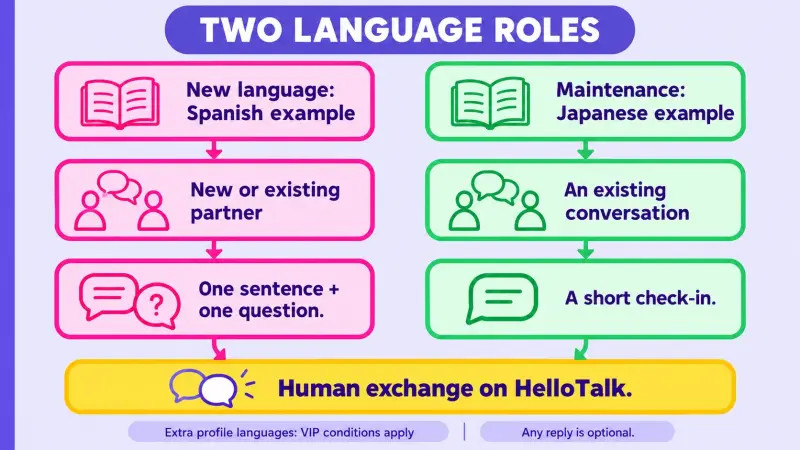
Two-language setups are rarely symmetrical. One language is the one you are actively building; the other is mostly the one you do not want to lose. Writing that difference into the settings is easier than leaving both half-configured.
The check below uses one worked pair: Spanish as the new language, Japanese as the maintenance language. It assumes an account that can hold both profile languages at once, and HelloTalk's FAQ puts those extra teaching or learning languages under VIP. If your account holds one at a time, change it within the frequency your membership allows, or keep the second language inside threads you already have. Swap in your own two languages.
| Field to open | New language (example: Spanish) | Maintenance language (example: Japanese) | Why the value matters |
|---|---|---|---|
| Course selection in your lesson app | Set as the course you open first | Leave the course in the account instead of removing it, since Duolingo's post describes removal as permanent deletion of that course's progress | Removing is a discard decision, not a pause |
| HelloTalk profile learning languages | Listed, so the profile says this is what you are practising now | Listed only while you still want messages in it | HelloTalk's FAQ ties Advanced Search language criteria to these profile choices, and adding a second one is a VIP condition |
| HelloTalk Advanced Search filters | Filter for native Spanish speakers and open one new conversation | Skip the search and reply inside a thread you already have | A search narrows who you look for; it does not control who writes to you |
| The next message you send | On HelloTalk, send one sentence plus one narrow question a partner can answer in a line, so the feedback is small enough to use | On HelloTalk, send one short check-in in Japanese to a partner you have already talked to, so the language gets used with a person rather than only reviewed | Either message is an invitation that can go unanswered, and any reply is about that language, which a shared streak is not |
The two columns do different jobs. The new language may need a new contact, though not always: a partner you already message in Japanese might also speak Spanish, and asking inside that thread is one option before starting a search. The maintenance language mostly needs one thread that is still warm, where a few lines count as use rather than review.
Verify Current Access Limits for Your Languages and Account
All of that assumes the fields are available to your account, and membership is the part the help pages qualify most carefully. HelloTalk's FAQ attaches VIP conditions to adding two more teaching or learning languages, to changing learning languages at any time, and to changing or adding some Advanced Search criteria. If you want the free side mapped first, the breakdown of what HelloTalk includes for free is the closer read.
The other two products need the same caution. Busuu's switching help covers changing a course and finding earlier progress when you return, but it does not list which exercise formats exist in each language, so that stays an in-account check. Duolingo's post covers adding and removing courses and the shared streak, not what each course contains.
A company's total language count is a catalogue number, while what your own account holds at once is set by separate profile, plan, and search fields. Those are the fields worth screenshotting before you commit to a second language.
One limit on everything above: these are readings of current official help documents, not a walkthrough of the build on your phone. Menu names, placement, and membership labels differ between versions and regions, so open your settings, confirm each field exists where the documentation describes it, and trust what your account shows over any article, including this one.
If you are still deciding which apps deserve an account at all, the wider comparison of language learning apps by the job each one does covers that choice, and this page stays on the settings. When you are ready to set the profile languages and search filters described here, open HelloTalk and check those two fields before your next message.
Frequently Asked Questions
Can I practice multiple languages with a single app?
Usually yes, but "practice" splits into parts that are configured separately. One account can commonly hold more than one course, and HelloTalk's FAQ describes a VIP account adding two more teaching or learning languages in profile Language settings. Which language you end up using with a person depends on profile choices, the search criteria you set, and the threads you already have, so check each field rather than a headline total.
If I switch courses, do I lose what I already finished?
It depends on the product and on the exact action. Busuu's help centre describes earlier progress as still there when you return to a course. Duolingo's post describes removing a course as permanently deleting that course's progress. Switching away and removing are different decisions, so make the destructive one on purpose rather than while cleaning up a menu.
Does a long streak mean I practised both languages?
No. Duolingo's post says any lesson you complete counts toward the single overall streak, so the number can grow for months while one course goes untouched. If you want something specific to the second language, look at what you actually did in it, such as a message you sent in that language and whatever answer came back.
How many learning languages can my HelloTalk profile hold, and how often can I change them?
HelloTalk's FAQ describes a VIP account adding two more teaching or learning languages in profile Language settings, and separately describes change frequency: VIP at any time, non-VIP once every two days. Those are two different numbers, and neither equals the total number of languages the platform supports across all users.
Why do partners keep writing to me in the language I paused?
There is more than one possible reason, so check instead of assuming. Your profile may still list that language as what you are learning, and HelloTalk's FAQ ties the Advanced Search language criteria to those profile choices. Threads also tend to continue in the language they started in, and the other person decides what to write. Updating the profile language is one field you control, not a switch that changes incoming messages.
Do I need a paid plan to practise two languages?
Not necessarily, although several fields are membership-gated. HelloTalk's FAQ describes VIP conditions for adding two more teaching or learning languages, for changing learning languages at any time, and for some Advanced Search criteria. Busuu's switching help does not list which formats are free in each language. Confirm entitlement inside each account, since documentation describes the rule and your account shows the version applied to you.
Should I use one app for both languages, or separate apps?
Both arrangements work, and the tradeoff is visibility. One account keeps the settings in a single place but merges signals, which is how a shared streak covers an unused course. Separate apps keep the records apart and double the setup you have to check. Choose by which failure you would actually notice first.