
When a Language Partner Asks for Money or an Investment: What to Do

You have been trading voice notes with the same person for a couple of weeks. The corrections are useful, the time zones finally line up, and then a message arrives that has nothing to do with language: a family emergency, a small loan until Friday, or a trading account that supposedly needs only a small deposit to open. The friendly tone has not changed, which is exactly what makes the next move confusing.
A request for money, financial details, or an investment account is the point to stop the conversation, no matter how good the language practice has been. That is not a verdict about the person, and you do not have to work out whether they are telling the truth. It is a rule about the request itself, which keeps the decision simple at the moment it is hardest to think clearly.
Which Requests Should Make You Stop the Conversation
The HelloTalk safety page covers money requests, investment invitations, and suspicious links among the risks to watch for while using the app. What makes them harder to handle in practice is that a request can arrive inside a conversation you have been enjoying, sometimes with a story attached that would feel rude to question if a friend told it.
The table below groups the request types this article covers, one way each can appear in a language chat, and a response that does not require you to decide what the other person intended.
| Request | How it can show up in a language chat | What to do |
|---|---|---|
| Direct money request | An urgent bill, a family emergency, travel costs, a fee to keep something open | Do not send. Check the story through your own channels, not theirs |
| Investment or trading invitation | A mentor, screenshots of returns, an account that starts with a small deposit | Do not register or deposit. End that topic |
| Gift cards, top-ups, or crypto transfers | Presented as faster or easier than a bank transfer | Treat as a stop signal. These transfers are difficult to reverse |
| Financial or identity details | Card numbers, bank details, ID photos, a request to prove who you are to them | Do not share. Language practice does not need them |
| A link or app to install | A trading site, a wallet, a login page, a better chat app | Do not open it. Links can lead to fake sign-in pages |
| Receiving or forwarding money or packages | Framed as a favor, a job, or help with customs fees | Refuse. This can pull you into someone else's transaction |
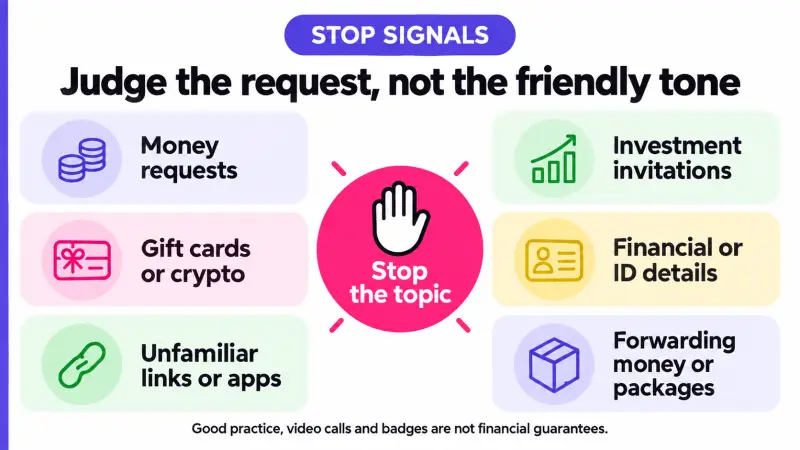
Notice what is not on that list. Someone mentioning that they work in finance, or asking what you do for a living, is ordinary conversation. The line worth watching is the moment a chat asks you to move money, credentials, or documents. Judging people by nationality, gender, a profile photo, or how fluent they sound tells you nothing useful, and it will make you suspicious of good language partners while missing the actual request.
Why Moving Off-App Can Make the Situation Harder to Report
A money request can arrive with a second suggestion: continue this on another messenger. Some people prefer a different app for ordinary reasons, so the suggestion alone is not proof of anything. It does change what a later report has to work with.
Moving a conversation to another app does not invalidate a HelloTalk report, but it does leave fewer in-app messages for that report to reference. HelloTalk's official guidance lists separate reporting entry points for messages, Moments posts, comments, group chats, Voicerooms, and livestreams, so a report is built around the account and the content that sits inside the app. If the part that worried you happened elsewhere, you can still report the HelloTalk account and include relevant evidence you are able to provide safely. HelloTalk's content policy states that information from other platforms or from offline situations can be taken into account when an account is reviewed, and HelloTalk cannot control what happens on a service it does not run. The other app will have its own reporting tools, and those are worth using as well.
Whether you hand over a private contact detail at all is a separate decision, and it stays yours at every stage. Choosing to share one does not make a financial request reasonable later. If that question is already sitting in a chat you like, it helps to think through what to keep private during a language exchange before you answer.
What to Do Before Sending Money or Opening a Link
If you are still weighing a request, a short pause does more than any amount of analysis inside the chat window. None of these steps require you to accuse anyone of anything.
- Do not send money, and do not open links or install apps offered in the conversation. You can leave a reply for a day without owing an explanation.
- Look up any organization mentioned in the story by yourself. If a bank, a school, a delivery company, or a trading platform is named, find its official contact details independently instead of using a number, link, or account sent to you. Checking independently tells you what that organization actually says, and it is not a step toward approving a transfer. Even when the details check out, the money request stays a reason to stop.
- Say the request out loud to someone you trust. These approaches rely on privacy and urgency, so bringing one person outside the chat into it gives you a second reading of the same message.
- Answer in one sentence if you want to answer at all. Something like "I do not send money or share financial details with people I know from an app" is complete. It does not need softening, and it is not an invitation to negotiate.
Chat history, fluency, a verification badge, and time spent on a video call do not guarantee that a money request is safe or legitimate. A camera shows a face, not a name, a job, or a reason to transfer funds. A detailed profile and a pleasant tone do not carry any more weight.
You also do not owe anyone a warning, an argument, or a finished packet of proof before you leave. If pressure continues after a clear no, you can stop replying and move straight to blocking and reporting the unwanted contact. Saving what is already in the chat is optional, and only worth doing when it feels safe and easy.
What to Do If You Have Already Shared Information or Paid
If a payment already went out, the responsibility for that sits with the person who asked. What matters now is what you can still do.
If you have already paid, the most useful next step is to contact your bank or payment provider promptly, through contact details you look up yourself, and ask what options exist for that payment method. Use the number printed on your card, the provider's own app, or the official site you navigate to directly. Options depend on the payment type and how quickly it is reported, and nobody can promise that money comes back.
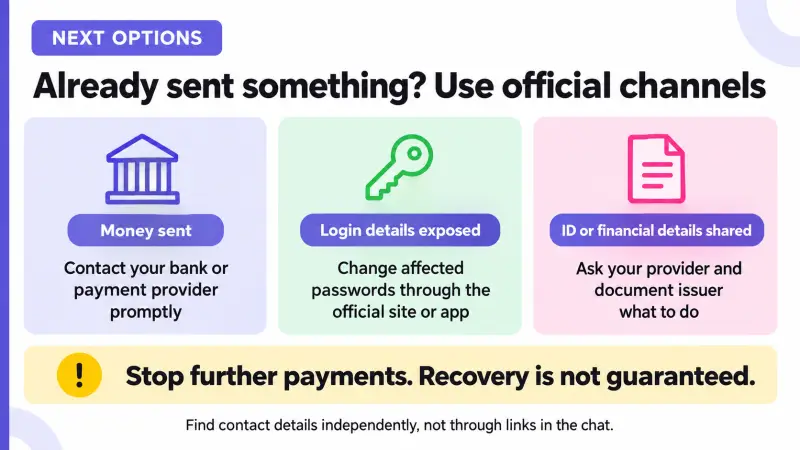
A few other steps apply depending on what left your hands.
- Stop sending anything further, including fees described as necessary to release, unlock, verify, or withdraw funds. A request for another payment in order to recover an earlier one follows the same pattern as the first request.
- If you entered login details on a page reached from a link, shared a password, or believe an account was accessed without your permission, change that password and any place you reused it through the service's official site or app, and switch on any extra login protection it offers. Opening a page on its own does not mean an account has been compromised, so check sign-in activity where a service shows it rather than assuming either way.
- If you shared ID documents or financial details, ask your bank or payment provider what monitoring it offers, and check what the authority that issued the document advises. Consumer protection and police reporting options differ by country, so look up what applies where you live.
- Be careful with anyone who contacts you afterward offering to recover the money, especially if they ask for a payment to do it.
Reporting inside the app is still worth doing, and it helps to know what that report covers and what it does not.
Where HelloTalk's Reporting Tools Fit, and What They Cannot Promise
HelloTalk's safety materials describe a combination of technology, human moderation, and community reports, and the HelloTalk content policy prohibits scams, spam, impersonation, and sharing other people's private information without permission. HelloTalk can restrict content and accounts that violate those policies. HelloTalk's official guidance on money requests and financial information also states plainly that the app is for language exchange rather than dating, which is useful context when a conversation drifts toward personal favors.
HelloTalk's documented process is that the safety team reviews reports, may ask for additional information, and can warn or restrict accounts when the evidence shows a policy violation. That guidance does not promise a fixed processing time or a particular outcome for any specific account.
HelloTalk's safety team can review reports and restrict accounts under the platform's policies, but a report is not a transaction-reversal service and cannot promise that money comes back. A report is also not an emergency service. If you are in immediate physical danger or someone has made a credible immediate threat, contact local emergency services. If the threats or unwanted attention are ongoing but not immediate, local authorities or a trusted support organization in your country may be able to help alongside the platform report.
After an exchange like this, you might want to get straight back to practicing, take a few days away, or stay off that part of the app for a while. All three are fine, and none of them are owed to anyone. Language exchange on HelloTalk runs on two-way corrections with people learning your language, and that trade has never required money, financial details, or an account on somebody else's platform.
Frequently Asked Questions
Is it ever normal for a language partner to ask for money?
Paying a chat partner is not part of a reciprocal language exchange. Two learners trade practice and corrections, and neither side needs to send money, card details, or identity documents for that to work. Buying a language service such as tutoring is a separate decision you make through that provider's own official channels, which is not the same as a partner in your chat asking you to send funds, cover an emergency, or deposit into an account. HelloTalk's safety guidance names money requests, investment invitations, and requests for financial information as things to watch for.
What if we have been talking for months and everything else feels genuine?
A long, friendly history does not change what the request asks you to do. Weeks of good practice can be exactly that, and the person may still be someone you enjoyed talking to, but neither possibility makes sending money reasonable. Keep the rule attached to the request rather than to your read on the person.
Does a video call or a verified badge mean the request is legitimate?
No. A video call shows you a face and a voice, not an identity, a job, or a reason for a transfer. HelloTalk's public FAQ on verification describes badges offered by invitation to notable accounts, and that page does not document every check the platform may run, so it is not evidence either way about a particular person. A badge or a call is not a safety guarantee and not a reason to trust a financial request.
Can HelloTalk recover money I already sent?
A report to HelloTalk goes to the safety team for review under the platform's policies. It is not a transaction-reversal service, and no report can promise that money comes back. Reporting still matters, because it gives the safety team something to review. For the payment itself, contact your bank or payment provider promptly through official contact details you look up independently, and ask what options exist for the method you used.
Should I keep the conversation going to collect evidence before reporting?
No. You can stop at any moment, and you do not need a complete record before you block or report. HelloTalk's documented reporting guidance suggests including relevant conversation evidence, which means what is already in the chat rather than new messages you go back and collect. Submit it through the official reporting channels rather than posting someone's messages publicly.