
Is HelloTalk a Dating App? How to Keep Exchanges Focused on Learning

HelloTalk is a language exchange app, not a dating app, and HelloTalk's official help material states that the platform is not a dating service. That answer still leaves the awkward part unsolved. You open a chat to practice Spanish, the first few messages are about past-tense endings, and then the replies drift: a comment on your profile photo, a question about whether you are single, a "you look nice today" arriving where you asked for a correction. You want the practice, you do not want that conversation, and you are not sure whether saying so makes you the difficult one.
Why Friendly Conversation Does Not Mean Consent to Flirting
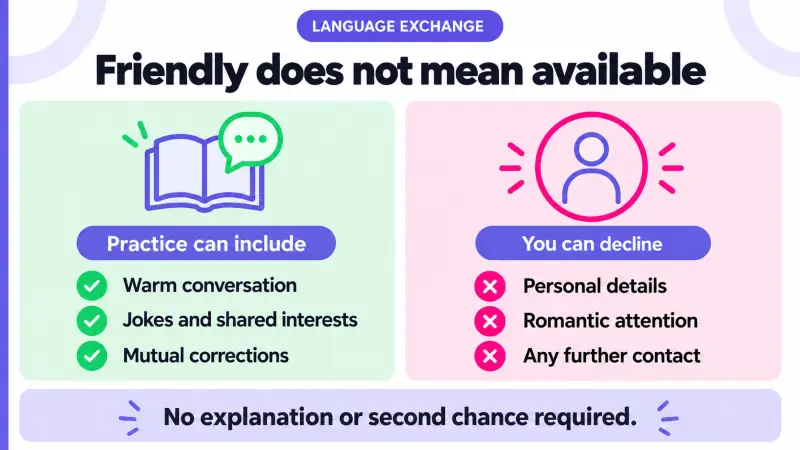
Language practice needs some social warmth. You ask where someone lives so there is something to talk about, you react to a weekend photo because that produces vocabulary no textbook chapter hands you, and you attempt a joke because jokes are hard in a second language. All of that is lesson material. None of it is a statement about your availability.
Being friendly in a language exchange is not consent to romantic or sexual attention, and you do not owe anyone an explanation for steering a conversation back to learning.
It runs the other way too. Not every compliment is harassment, and some learners do end up with steady practice partners they genuinely like. What decides the matter is what you are comfortable with, not whether a stranger meant well. You can decide that a first message about your body is already the wrong conversation, and you can act on that without waiting for it to happen twice.
HelloTalk's reporting guidance describes one reportable scenario as someone who is not interested in language learning and uses the app for flirting or sexual talks, and HelloTalk's content policy separately prohibits unwanted sexual advances regardless of what the sender intended. A quiet account, or a partner who rarely discusses study methods, is not evidence of misconduct by itself. What you can act on is behavior aimed at you, and you do not need a prior warning or proof of someone's main purpose before reporting something unwanted.
Two questions are worth keeping apart here: what you actually observed in a chat, and what that observation proves about the other person. The table below separates them and lists choices that stay open to you. It is a menu, not a ladder you have to climb in order.
| What you notice in the chat | What it does and does not tell you | Choices that stay open to you |
|---|---|---|
| Questions about your city, job, or weekend mixed in with corrections | Ordinary conversation that can generate useful vocabulary; it does not mean you have to disclose personal details | Answer at whatever level of detail suits you, or keep the topic on the language |
| A compliment, then the person returns to your grammar question | The topic moved back; one friendly message on its own does not tell you how someone will behave later | Continue if you want to, or restate the kind of practice you are looking for |
| Appearance or relationship-status messages after you have said you are here to study | Your stated boundary is not being followed, whatever the sender meant by it | Stop replying, close the chat, block, or report; no second incident is required first |
| An early push for your phone number, private social accounts, or a late-night video call | Language practice does not require any of these, and agreeing proves nothing about the other person either | Decline without justifying yourself and keep the practice inside the app |
| Suspicious links, or pressure connected to money, payments, or investments | HelloTalk names these as warning signs on its safety page | Stop replying and report the account rather than negotiating |
Nothing in that middle column tells you what a stranger was thinking. It does tell you when a conversation has moved away from what you came for. If you would like to signal that earlier, stating your learning goal is one option worth having.
How to Make Your Language-Learning Goal Clear
Saying what you want out of practice is optional. Some learners prefer to keep a bare profile and sort conversations as they come, and that is a legitimate choice. If you would rather set the frame early, two places are worth a few minutes: your bio and your first message.
A bio that names your target language, your rough level, and the format you want gives the other person something specific to respond to. An opening message that starts with a task does the same thing better than "hello" does. A few lines that work:
- "Studying B1 Spanish. Looking for about ten minutes of voice practice most evenings and honest corrections on my word order."
- "Japanese learner around N4. Happy to correct English writing in return. Text practice only for now."
- "Working on French pronunciation this month. Could you read this sentence back and tell me which sounds are off?"
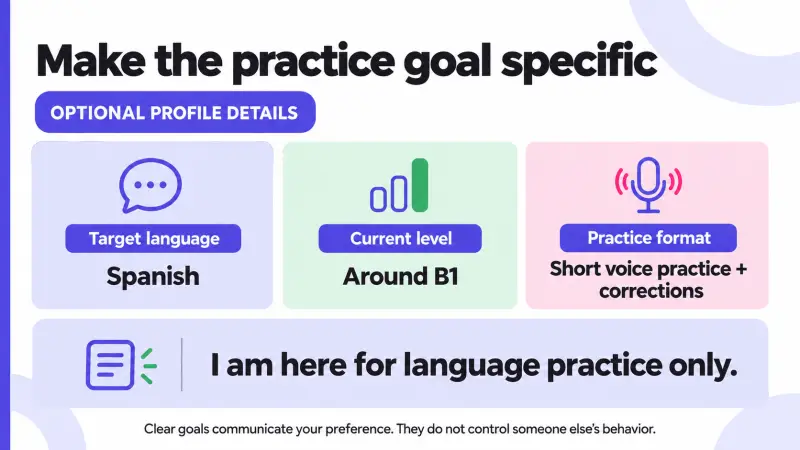
Stating your learning goal clearly tells a partner what kind of practice you want, but it cannot control how another person responds, and unwanted contact is never caused by how the recipient wrote a profile. Keep that separation in mind if anyone ever suggests you invited the problem.
Clear wording does give you a neutral script for later. "I am here for language practice only" is a complete sentence. You do not need to soften it, share your relationship status, or ask anything about a stranger's personal history to earn the right to say it. And you can say it in month six of a friendly exchange just as easily as in message two.
If you are still working out which parts of the app suit your routine, this walkthrough of HelloTalk's learning features in daily practice covers what chat corrections, community posts, and voice rooms are each useful for.
Clear wording communicates what you want. It does not decide what the other person does next, which is what the following section is about.
What to Do When Someone Ignores Your Boundary
You can stop replying, leave the chat, block, or report at any point and in any order, with no warning, no closing explanation, and no complete file of evidence. There is no required sequence, and nothing obliges you to give a person a second chance first.
Silence is a complete answer, because ending a conversation needs no announcement. Blocking is the tool for stopping that account's messages from reaching you, and it is not a promise that the other person can never notice or reach you anywhere in an app. Reporting is the step that puts the behavior in front of HelloTalk's safety team, and reporting and blocking are independent: you can do either one, both, or neither.
Saving evidence is optional and only worth doing when it is safe and quick. HelloTalk's documented guidance asks for the conversation evidence connected to a complaint, so leaving the relevant chat intact can help if you decide to file one. If leaving fast matters more to you, leave. One thing to avoid either way is posting another person's screenshots or private details publicly to warn other learners, since sharing someone's private information without permission is against HelloTalk's rules in its own right. When you do have relevant evidence and it is safe to send, share it privately through the official reporting channel.
The step-by-step version, including what HelloTalk's help pages say happens after a report is filed, sits in the guide on ending unwanted contact, blocking, and reporting.
How HelloTalk's Safety Rules Support Learning-Focused Exchanges
Those options exist because HelloTalk publishes rules about what the app is for. The current HelloTalk safety guidelines cover protecting your personal information, treating suspicious links and money or investment requests as warning signs, staying cautious when someone pushes to move the conversation to another platform, ending contact that makes you uncomfortable, and using blocking and reporting. HelloTalk also prohibits sharing someone's private information without permission, along with impersonation, scams, and spam, and states that content or accounts can be restricted when policies are broken. HelloTalk notes that some features carry age restrictions as well.
HelloTalk's safety page describes moderation as a combination of technology, human review, and community reports, which means a report is one input into that process rather than the only thing that can trigger it. HelloTalk's published safety and reporting guidance does not promise a fixed review time or a particular outcome for any individual case, and published rules are not a guarantee that talking with strangers online carries no risk. Rules define what is prohibited and what action becomes possible. That is a smaller claim than a guarantee, and worth reading as one.
It also helps to know that one-to-one chat is not the only format. The HelloTalk platform supports Moments posts, where you can put a short paragraph in front of the community, and voice rooms, where you can listen before deciding whether to speak. These change how much of your practice happens in a private thread and how much you choose to join, which some learners prefer. Public and group spaces are not automatically safer, they can carry unwanted behavior too, and no format promises that anyone will reply.
If you want to keep learning after closing one chat, the formats across HelloTalk include text exchange, community posts, and voice rooms, so you can pick the one that fits the practice you actually want this week.
Frequently Asked Questions
Is HelloTalk a dating app?
No. HelloTalk is built for language exchange, and HelloTalk's official help material states that the platform is not a dating service. Friendships do form there, and some conversations become personal because both people want that, but romantic pursuit is not the purpose of the app. HelloTalk's reporting guidance describes using the app for flirting or sexual talks instead of language learning as reportable behavior.
Is flirting against the rules on HelloTalk?
HelloTalk's reporting guidance describes someone who is not interested in language learning and uses the platform for flirting or sexual talks as a scenario you can report, and HelloTalk's content policy separately prohibits unwanted sexual advances. You do not have to establish what someone's main purpose was before an unwanted advance is worth reporting. A compliment from a partner who then returns to correcting your grammar is a different situation from messages that keep pushing after you have said what you came for.
Do I have to explain why I am ending a conversation?
No. You can leave a chat with no warning, no reason, and no closing message. Whether you explain anything is entirely your call, and making a stranger comfortable with your decision is not your responsibility. If you would rather say something, one line covers it: "This is not the kind of practice I am looking for."
Will the other person know if I block or report them?
HelloTalk's help pages state that blocking and reporting do not send a notification to the other person. They also note that an account trying to message someone who has blocked it can run into an indication that the message was not delivered. Treat blocking as a way to stop contact reaching you, not as a way to stay invisible.
Can a language exchange turn into a real friendship?
It can, and that is not a policy problem. The difference is consent and pace. In a friendship, both people move toward it, personal details get shared because both want to share them, and either person can pull back to plain language practice without the other treating it as a betrayal. Interest that is not mutual is not automatically misconduct. Pressure that continues after you have declined is the behavior to act on.