
How to Say I Love You in Spanish: Te Amo vs Te Quiero vs Me Gustas
If you type “I love you” into a translator, Spanish usually hands you te amo. That is the trap. English stacks liking, caring, and being in love into one sentence. Spanish splits the weight. Learners send te amo to someone they have known for two weeks, or te quiero to a partner who expected something heavier, then cannot figure out why the reply feels strange.
This is not a catalog of pickup lines, and it is not dating advice. It is a register map: me gustas (I like you), te quiero (everyday love), te amo (deeper love). Get the weight wrong and a native speaker hears a different relationship than the one you meant.
The useful question is not “what is the Spanish for I love you?” It is “which of these would a speaker from Spain or Latin America actually say to this person?
The three levels that actually matter
Spanish love vocabulary works like a ladder. Each rung means something genuinely different, and native speakers feel the difference instantly. Skipping a rung — or using the wrong one — can create confusion, awkwardness, or an accidentally very intense moment.
Me Gustas — "I Like You" (The Crush Stage)
Me gustas literally translates to "you are pleasing to me," but in everyday speech it simply means "I like you" — in a romantic or attracted way. This is the phrase you use when you're interested in someone but haven't crossed into "love" territory yet.
Key things to know:
- Me gustas is about attraction and interest, not deep affection.
- It's commonly used in early dating, crushes, or when confessing feelings for the first time.
- Adding mucho makes it stronger: Me gustas mucho = "I really like you."
- It's not something you typically say to friends or family — that would come across as odd.
Example to check with a native speaker: "Llevo semanas queriendo decirte algo… me gustas mucho." (I've been wanting to tell you something for weeks… I really like you.)
Te Quiero — Everyday Love (The Workhorse)
This is the most versatile and commonly used "I love you" in Spanish. Literally "I want you," te quiero has evolved to mean warm, genuine affection — the kind you feel for people who matter in your life.
You can say te quiero to:
- Romantic partners (especially in Spain, where it's the default even for serious couples)
- Close friends
- Family members (parents, siblings, children)
- Even pets
It's warm, safe, and appropriate in almost any close relationship. Adding mucho intensifies it: Te quiero mucho = "I love you a lot." If you're ever unsure which phrase to use, te quiero is almost always the safe choice.
Example to check with a native speaker: "Cuídate mucho, ¿vale? Te quiero." (Take care, okay? I love you.) — said to a friend or family member.
Te Amo — Deep, Serious Love (The Big One)
Te amo is the heavyweight. It means "I love you" at the deepest level — passionate, committed, once-in-a-lifetime kind of love. This is not casual.
When te amo fits:
- Long-term romantic partners, spouses, fiancés
- Very close family in some Latin American cultures
- Moments of high emotion (weddings, goodbyes, reconciliations)
When te amo might be too much:
- Early dating (saying te amo after two dates can feel overwhelming)
- Friends (in most regions, this would be unusual)
- Casual acquaintances
In Spain, te amo can sound almost theatrical — like a line from a telenovela. Spaniards generally prefer te quiero even for serious romantic partners. In much of Latin America (especially Mexico, Colombia, and parts of Central America), te amo is a normal, serious declaration between committed couples.
Example to check with a native speaker: "No importa lo que pase, siempre te amaré." (No matter what happens, I will always love you.)
Quick Comparison: All Three at a Glance
| Phrase | English weight | Who it usually fits | What goes wrong |
|---|---|---|---|
| Me gustas | I like you (attraction or fondness) | Someone you are into, not a full declaration yet | Too weak if you already have a long-term partner |
| Te quiero | I love you, in daily life | Partner, family, close friends | Can feel light if the other person wanted te amo |
| Te amo | I love you, at full weight | Romantic partner; in some countries, family too | Too heavy for a new crush or a language-exchange friend |
Beyond the Big Three: Te Adoro and Other Expressions
Te Adoro — "I Adore You"
Te adoro sits somewhere between te quiero and te amo in intensity. It means "I adore you" and carries a sense of deep fondness, admiration, and affection. It's warmer than te quiero but not as heavy as te amo.
- Often used between close friends as an exaggerated but affectionate expression
- Can be used romantically as a softer alternative to te amo
- Common in Latin America; less frequent in everyday speech in Spain
Example: "¡Te adoro, eres la mejor amiga del mundo!" (I adore you, you're the best friend in the world!)
Other Useful Expressions
Spanish | English | When to use it |
|---|---|---|
Estoy enamorado/a de ti | "I'm in love with you" | A direct confession of romantic love; match gender (enamorado for men, enamorada for women) |
Me haces feliz | "You make me happy" | A warm, low-pressure compliment that works in dating and established relationships |
Te extraño | "I miss you" | When someone is far away; common between partners and close family |
Eres mi media naranja | "You're my other half" (lit. "my half orange") | A playful, endearing term for a romantic partner |
Me volviste loco/a | "You drive me crazy" | Playful expression of strong attraction; use with someone you're already close to |
Spain vs. Latin America: The Same Words, Different Weights
This is where most learners get tripped up. The same phrase can feel completely different in Madrid versus Mexico City. Spanish is spoken across 20+ countries, and the emotional register of these phrases shifts by region.
| Phrase | In Spain | In Latin America |
|---|---|---|
| Te quiero | The default "I love you" for everyone — partners, family, friends. Even married couples say this daily. | Warm affection for family and friends; also used in early or casual dating. Not the deepest declaration. |
| Te amo | Rare in everyday speech. Can sound poetic, dramatic, or like a telenovela line. Saved for very emotional moments. | A normal, serious declaration between committed couples. Common in Mexico, Colombia, Central America, and parts of South America. |
| Me gustas | Works the same: "I like you" for crushes and early dating. | Works the same: "I like you" for crushes and early dating. |
| Te adoro | Used occasionally, often playfully between friends. | More common; used between friends and as a softer romantic alternative to te amo. |
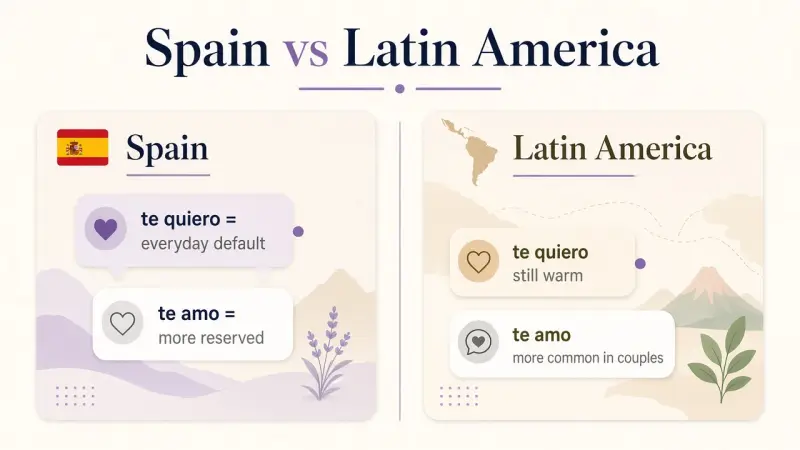
Key takeaways:
- In Spain, te quiero does almost all the heavy lifting — for partners, family, and friends alike. Te amo is rare and can sound dramatic.
- In Latin America, the line is clearer: te quiero for affection and casual warmth, te amo for serious romantic love.
- Me gustas works similarly across regions as the "I like you / I'm interested in you" phrase.
- Terms of endearment (cariño, mi amor, mi vida) also vary by country — another reason to learn from real speakers.
Real Scenarios: What Would a Native Speaker Actually Say?
Phrases make sense in context. Here are common situations and the phrase a native speaker would most likely reach for:
- You've been on three dates and want to show you're interested. → Me gustas mucho. ("I really like you.") Warm, honest, not overwhelming.
- You're texting your best friend after a long, supportive conversation. → Te quiero, hermano/a. ("I love you, brother/sister.") Natural and affectionate.
- Your anniversary, married five years, living in Mexico City. → Te amo. A serious, expected declaration.
- Your anniversary, married five years, living in Madrid. → Te quiero mucho, mi vida. ("I love you a lot, my life.") Spaniards rarely drop te amo in daily life.
- You want to tell your mom you love her. → Te quiero mucho, mamá (universal) or Te amo, mamá (common in Latin America).
- Saying goodbye to a close friend at the airport. → Te quiero, cuídate. ("I love you, take care.") Warm and natural across regions.
- You want to tell someone you've fallen for them, for the first time. → Estoy enamorado/a de ti. Direct, clear, and appropriate for a serious confession.
If you also want to check tone, record one short sentence instead of sending a long speech. Ask your partner what emotion they hear before explaining what you intended. The HelloTalk Voice Rooms can also expose you to the phrases people actually use in naturally paced conversations, although you should always respect the topic and boundaries of the room.
For more regular speaking work, use the routine in How to Practice Spanish Speaking Every Day. A phrase becomes easier to use naturally when you have practiced the surrounding conversation, not only the declaration itself.
FAQ
Can I use te amo with family?
In some Latin American families, yes. In much of Spain, te quiero is the normal family line and te amo can sound like a soap opera. Do not guess from a movie. Ask one parent-aged speaker from that country if you can. Their hesitation is data.
Is te quiero romantic or friendly?
It can be either. Partners use it romantically, while relatives and close friends may use it affectionately. The surrounding words, tone, and relationship tell the listener which meaning is intended.
How do I know which one to use if I'm unsure?
Start with te quiero — it's the safest and most versatile phrase, appropriate for friends, family, and partners in almost every Spanish-speaking region. If you're confessing romantic interest for the first time, use me gustas. Save te amo for serious, committed relationships. And when in doubt, ask a native speaker from the specific country you're interested in — regional differences matter, and native speakers love explaining them.
What can I say if te amo feels too strong?
Depending on the relationship, try me gustas mucho, me encantas, me importas mucho, or te quiero. You can also describe the feeling more specifically: Me encanta estar contigo means “I love being with you.”