Duolingo vs HelloTalk for English Speaking Practice: How to Go From Lessons to Real Conversations
You can keep a Duolingo streak for months and still freeze when someone asks, “What did you do this weekend?” You know the words. You may even recognise the grammar. But when it is your turn to answer, the sentence does not arrive in time.
That does not mean the lessons were useless. It means that recognising English and producing it in a conversation are different skills.
The short answer: use Duolingo for structured lessons, review, and habit-building. Use HelloTalk when you need to turn what you know into messages, voice notes, and conversations with other people. If spoken English is your priority, you may not need to delete Duolingo—but you do need regular practice that makes you form your own answers.
What each app actually trains
Do not read this as a contest over which app has more features. Read it as a choice about what you need to practise today.
What you need | Duolingo | HelloTalk |
A daily study habit | Strong. Short lessons and streaks make it easy to return. | Less structured. You have to start or join an interaction. |
Vocabulary and grammar review | Strong. Lessons provide guided practice and immediate feedback. | Indirect. You learn words and patterns while trying to communicate. |
Guided speaking practice | Speaking exercises are built into lessons. Some courses and plans also offer AI conversation features such as Roleplay and Video Call. | You choose what you want to say and can rehearse through text or voice notes. |
Unscripted conversation with people | Not the main experience. AI conversation can help you rehearse, but it is not a human exchange. | Core use case. You can use text, voice messages, calls, and Voice Rooms. |
Feedback on your own wording | Automated feedback within the exercise or AI conversation. | A language partner can correct the sentence you actually wrote or said. |
Best fit | Building a foundation, reviewing regularly, and keeping a study habit. | Turning existing knowledge into real communication. |
Main limitation if used alone | You may get better at lessons without getting enough human conversation practice. | It is difficult to sustain a conversation if you do not yet have enough basic language to form a simple message. |
Duolingo is useful when you need structure. Its regular lessons cover reading, listening, writing, and speaking, and its current speaking tools go beyond simply tapping an answer. Duolingo Max also includes AI-powered conversation features in supported courses. These tools can make speaking practice less intimidating and help you rehearse more often.
But an AI conversation and a human exchange still ask different things of you. A person may change the subject, misunderstand you, use an unfamiliar expression, or ask a follow-up question you did not expect. You also have to notice when your message sounds too formal, too direct, or simply unlike the way people normally speak.
That is where HelloTalk fits. Its current communication features include text, voice messages, video calls, correction tools, translation, and Voice Rooms. HelloTalk says its community includes more than 70 million users across 260+ languages. The value is not the number by itself; it is the chance to use English with people who are also there to exchange languages.
A practical decision: keep Duolingo if it gives you useful structure or keeps you studying. Add HelloTalk as soon as you can write a few simple sentences of your own. Do not wait until you have “finished” a course before you start using the language.
Why a long streak can still leave you unable to speak
A lesson and a conversation place different demands on your memory.
A lesson might show you:
I ___ to the store yesterday.
You recognise the tense, choose went, and move on.
A conversation sounds more like this:
What did you do after work?
Now there are no options. You have to retrieve a verb, build a sentence, say it, and respond to whatever comes next.
Three differences matter most:
1. You have less time. An app will wait while you think. A live conversation keeps moving.
2. The question is not scripted for you. You cannot know exactly what another person will ask or how they will phrase it.
3. You have to repair mistakes. Real speaking includes phrases such as “Sorry, I meant…” and “I’m not sure how to say this, but…”. Keeping the conversation going is part of fluency.
This explains the familiar gap between “I understand it” and “I can say it”. If most of your practice asks you to recognise an answer, you may become good at recognition without getting enough practice at retrieval.
That does not make Duolingo a bad app. It means one app should not be expected to do every job. If you are comparing Duolingo and HelloTalk because you want to speak English, the real decision is not which app wins forever. It is how much of your study time should now involve another person.
A streak tells you that you returned to the app. A conversation tells you whether you can respond when the answer is not already on the screen.
A 14-day plan to start speaking without dropping your study habit
Treat the next two weeks as a test, not a promise of fluency. The aim is to find out whether regular, low-pressure output is the missing part of your routine.
Days 1 to 3: start with text on purpose
Set English as the language you want to practise. Make your profile specific: say roughly what level you are, what you enjoy talking about, and which language you can help with in return. Then look for English speakers who are learning your language.
Send a message that gives the other person something easy to answer:
Hi! I’m practising my spoken English and can help with [your language]. I’m around A2, and I’d prefer to start with short messages or voice notes rather than a live call. What kind of practice are you looking for?
Text is not a lesser form of practice. It gives you time to build a sentence without the pressure of live silence. More importantly, the sentence is yours. If your partner corrects it, the correction is connected to something you genuinely wanted to say.
Start small. One person who wants the same kind of exchange is more useful than dozens of conversations that stop after “hello”.
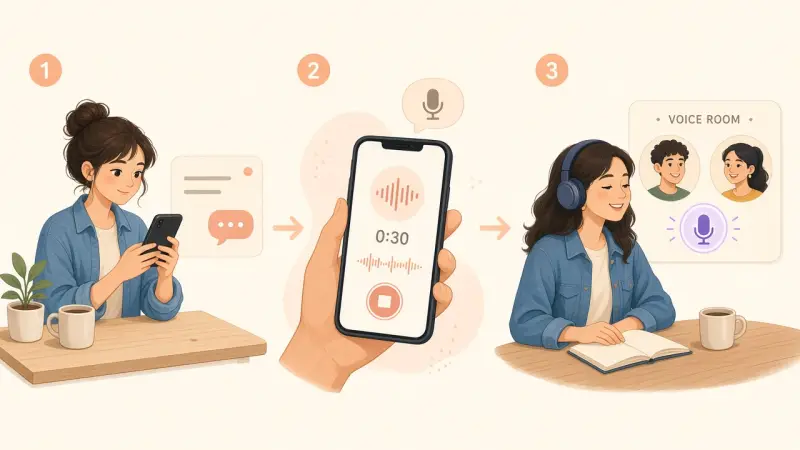
Days 4 to 7: turn one reply into a voice note
Once a text conversation is moving, send one short voice message instead of typing the same update. Twenty to forty seconds is enough. Talk about what you ate, something that happened at work, or a programme you watched. End with one question so your partner has a clear reason to reply.
Voice notes are a lower-pressure bridge to live conversation. You can pause, try again, and listen before you send, but you still have to retrieve the words yourself. If one sound repeatedly causes trouble, rehearse that sentence with a pronunciation tool, then use it again in a real message.
If you want the mechanics of starting a voice chat without turning it into a formal class, use HelloTalk’s voice chat walkthrough.
Days 8 to 14: listen in a Voice Room, then contribute once
Live conversation is often the step lesson-app users postpone. A group Voice Room can make it easier because you do not have to carry the whole exchange.
Join an English room and listen first. Notice how people enter the conversation, react, ask follow-up questions, and correct themselves. When you hear a topic you can handle, unmute and add one sentence or ask one question. That is enough for a first attempt.
The goal is not to sound impressive. It is to learn what happens to your English when you cannot plan every word in advance.
Who should keep Duolingo, and who should make HelloTalk the main app?
Choose by goal and current ability, not by loyalty to either app.
Your situation | Main app | What to add |
You cannot yet form a simple sentence | Duolingo or another structured beginner course | Try short HelloTalk text exchanges when you can introduce yourself and ask a basic question. |
You can read simple English but freeze when speaking | HelloTalk | Keep brief Duolingo review if it helps you stay consistent. |
You want conversation for travel, work, interviews, or everyday life | HelloTalk | Use Duolingo for targeted review, not as your only speaking plan. |
You already have a language partner but still open lessons first | HelloTalk | Move the minutes: send the message first, then do the lesson. |
You want low-pressure rehearsal before talking to people | Duolingo’s speaking or AI conversation tools, where available | Move a rehearsed answer into a HelloTalk voice note or conversation. |
Keep Duolingo as your main study app if you are still building enough language to express a basic idea. You can still start with very short HelloTalk messages; you do not need to wait for an intermediate level.
Make HelloTalk the larger part of your routine if you already understand simple English but struggle to answer in real time. At that point, another lesson may help you review, but it does not replace the practice of choosing your own words while someone is listening.
A few rules prevent the usual stall:
· Do not wait until you feel completely ready. Start with the English you have.
· Do not collect dozens of shallow chats. One reliable partner is enough to begin.
· Do not make day one a live call. Text and voice notes are useful steps, not shortcuts.
· Do not expect perfect English from every partner. Look for someone patient, responsive, and genuinely interested in an exchange.
· Agree on a simple format: for example, 10 minutes in English, 10 minutes in your partner’s target language, and one correction each.
If you want filters, first-message examples, and advice on moving from chat to a call without making it awkward, use the language exchange partner guide. Then go find someone: English language partners on HelloTalk.
FAQ
Is HelloTalk better than Duolingo for learning English?
It depends on the job. Duolingo is better suited to structured lessons, review, and habit-building. HelloTalk is better suited to using English with other people. If your main goal is spoken conversation, HelloTalk should usually take a larger share of your practice time.
Can Duolingo alone make me fluent in spoken English?
Duolingo can build vocabulary, grammar knowledge, pronunciation practice, and speaking confidence. Some plans also include AI conversation tools. But if your goal is to speak comfortably with people, you still need experience with unpredictable questions, different voices, misunderstandings, and follow-up responses.
When should I start HelloTalk if I am still doing English lessons?
Start when you can write a few simple sentences, even if they are not perfect. Begin with text, move to voice messages, and try a Voice Room or call when you want more live practice. You do not have to reach an intermediate level first.
Is HelloTalk free for English speaking practice?
HelloTalk offers free access to core communication and community features, while VIP adds additional benefits and higher limits for some tools. Feature availability and limits can change, so check the current plan details in the app before relying on a specific allowance.
Should I practise with AI or with a language partner?
Use AI for private rehearsal, repetition, and practice when no one is available. Use a language partner for unpredictable replies, social context, and the experience of keeping a real exchange going. They can complement each other, but they do not provide the same kind of practice.
How do I find someone to practise English with?
Set English as your target language, look for people who are learning your language, and send one specific message about the kind of exchange you want. Start here: find English language partners.
If spoken English is the goal, do not wait for the next lesson to make you feel ready. Find one person, send one message, and put some of your practice time where a real reply can happen.