
Enock’s HelloTalk Story: Writing Chinese Poems About a Year Away From Home
Published on
An Evening Chinese Exam, an Ice Cream, and a HelloTalk Post
After an evening Chinese exam in Chengdu, Enock went for ice cream. In a post on HelloTalk Moments, he recalled how the characters on the test had started to look alike. By the time he got to his chocolate ice cream, he was so tired that he nearly smeared it on his nose while yawning. That was the version of the exam he shared with his readers.
Enock came from Uganda to study cybersecurity as a graduate student at the University of Electronic Science and Technology of China in Chengdu. He chose the university for its reputation in technology and was curious about what it would be like to study in China. Outside class, he was also adjusting to a different language, routines, and city. Learning Chinese was part of that adjustment, but so was finding a way to describe what living abroad felt like.
He took photographs of campus buildings, green lawns, empty classrooms in the evening, and the streets he traveled after dark. His posts mixed these everyday scenes with reflections on his studies. They captured both the excitement of discovering a new place and the less visible parts of student life: exams, homesickness, and the quiet stretches between conversations.
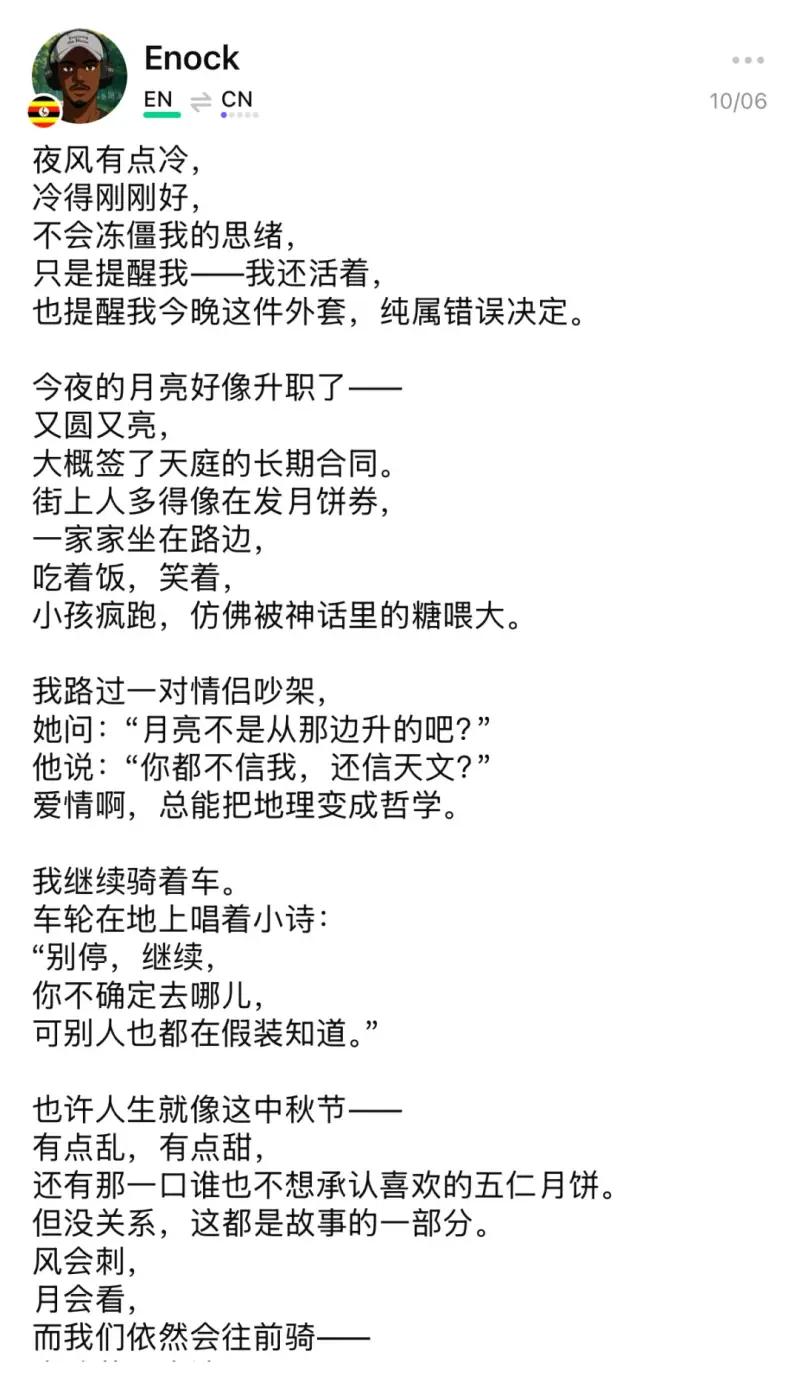
Enock shared original Chinese writing in HelloTalk Moments.
HelloTalk became one of the places where Enock recorded this experience. He used Moments to write in Chinese about meals, weather, school, and feelings that were not always easy to explain in person. Sometimes the writing took the form of a diary entry. At other times, it became a poem. One Mid-Autumn Festival post described a cool nighttime breeze, the moon, people spending the holiday together, and a sense of missing something even in the middle of a lively season.
These posts mattered because they were more than vocabulary exercises. Instead of limiting Chinese to textbook sentences, Enock was trying to express his own thoughts in a language he was still learning. The subjects were personal: feeling alone, making friends, becoming more independent, and learning to find comfort in small daily rituals.
His year in China also included experiences far beyond the classroom. He tried local drinks and Sichuan dishes, spent time with Chinese friends, and visited places around the region, including the Leshan Giant Buddha. During the Chinese New Year season, he took photographs with bright red decorations and handwritten festive couplets. Everyday encounters exposed him to local expressions and traditions that were difficult to learn from a textbook alone.
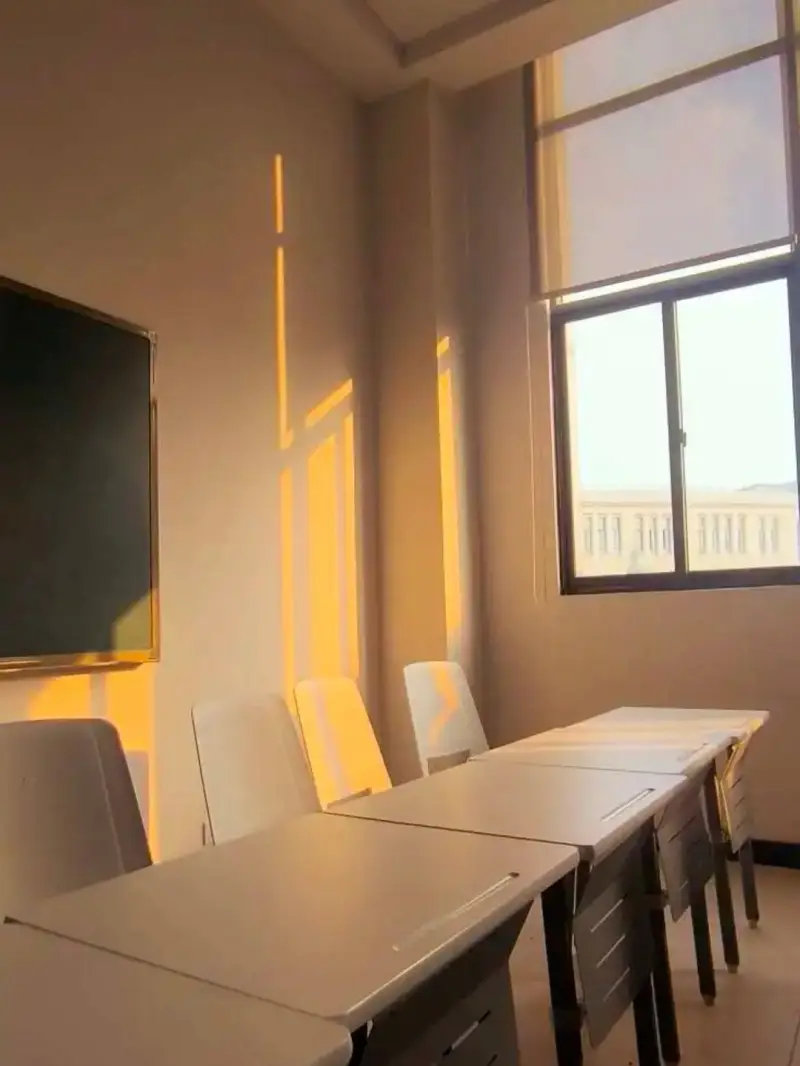
One of the classroom scenes Enock photographed during his studies.
There were harder moments, too. In his posts, Enock wrote about loneliness and the effort of adapting to another country. He did not present his year abroad as an uninterrupted success story. Instead, his writing made room for uncertainty alongside progress. That honesty gave his Chinese-language posts a distinctive voice.
In one exchange shown in the original article, a language partner complimented Enock’s writing. Enock said he read widely in his spare time and wrote in Chinese to keep up with his studies. His partner shared a reason for learning English: they hoped to read literature in the original and catch some of what gets lost in translation.
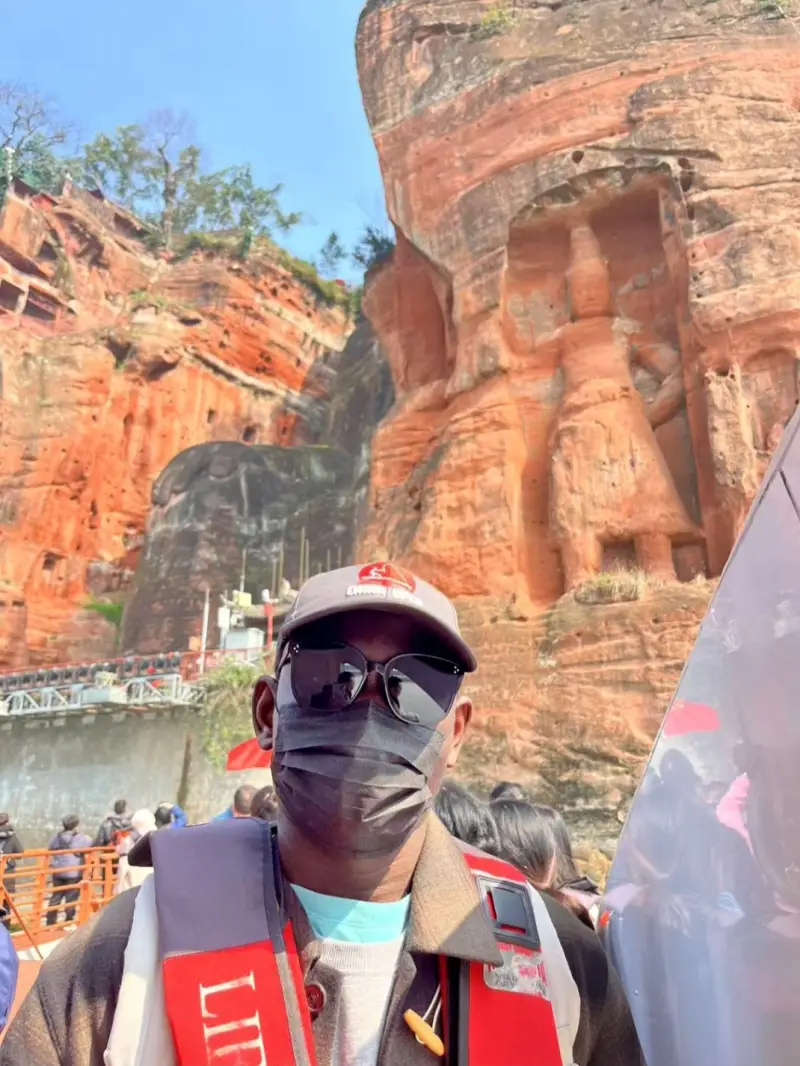
Enock photographed during a visit to the Leshan Giant Buddha.
By the time he reflected on his year in China, Enock had collected photographs, poems, conversations, and memories of places he had visited. His story is not about loneliness disappearing because he opened an app. It is about a student learning to put difficult feelings into words—and finding readers willing to respond. Chinese had become not only something to study for an exam, but also a language in which he could tell his own story.
Share a Small Moment in Chinese, Even Before You Have the Perfect Words
HelloTalk is a language exchange app that connects people learning different languages with native speakers. Enock’s writing offers one way to use it: turn something that happened today into a short post in the language you are learning. On Moments, you can share a photograph, write a few sentences about your day, or ask others whether a phrase sounds natural. You can also connect with language partners and continue a discussion through messages or voice messages. The goal does not have to be a polished poem. A small, genuine observation can be enough to start a conversation.
To begin, choose one picture from your day: a meal, a view on the way home, or a quiet corner of your school. Write three simple Chinese sentences: what the picture shows, what happened, and how you felt. Then add a question such as “How would a native speaker describe this feeling?” or “Is there a more natural way to say this in Chinese?” If someone offers a correction, try rewriting one sentence and using it in a follow-up message. You can also look for Chinese language exchange partners to practice discussing everyday experiences. With time, those short exchanges can become a record of how your language and your ideas develop.
Story and images from HelloTalk’s original WeChat article, published October 16, 2025.