
6 Common English Pronunciation Mistakes and How to Fix Them
You may know the right word and still hear someone ask, “What did you say?” That does not automatically mean your accent is the problem. One vowel, consonant, word ending, or stressed syllable may be making the word difficult to recognize. Find that part, practice it in a short phrase, and check whether another person understands it without seeing the text.
Common English pronunciation mistakes usually fall into six problems you can check separately: spelling, vowels, consonants, word endings, stress, and connected speech. You do not need to change your whole accent at once. Start with the one that affects the words you use most often.
Why Your English Pronunciation May Sound Unclear
English spelling does not always show how a word sounds. The same letter can represent different sounds, and a sound that is clear alone may become weaker in a sentence. Listeners also use context to guess what you mean, so a conversation can continue even when an important sound is missing.
That is why “Was my pronunciation correct?” is not always the most useful first question. Ask instead: Could the listener identify the word without my spelling, translation, or a long explanation? If the answer is no, choose one sound or stress pattern to work on.
The pronunciation examples in this article follow General American English. Other English accents may use different vowels or /r/ sounds, so choose one model for a practice session and keep the comparison consistent.
| What happens | What may be causing it | First thing to check |
|---|---|---|
| The listener understands after reading the message | The key sound is not clear enough in the recording | Send the audio first and hide the written sentence |
| Two words are repeatedly confused | You may not be making the difference between the two sounds clearly enough | Compare the two words side by side |
| A word is clear alone but unclear in a sentence | Stress, speed, or connected speech changes the sound | Slow down slightly and repeat the whole phrase |
| Long words are difficult to understand | The main stress is in the wrong place | Find the stressed syllable before practicing the details |

A regional accent can be completely understandable. Concentrate on the sounds that carry meaning rather than trying to imitate every feature of one speaker.
Common English Pronunciation Mistakes to Check First
1. Treating spelling as a complete pronunciation guide
English spelling can give you a first guess, but it cannot confirm the pronunciation. Silent letters appear in words such as know, write, and climb. The letters ough sound different in though, through, and rough. When you meet an unfamiliar word, listen to a recorded pronunciation before repeating it. Then say the word in a short sentence and check that the listener recognizes it without seeing the spelling.
2. Confusing similar vowel sounds
Vowels are a common source of misunderstanding because small changes in tongue position and mouth shape can create different words. Compare ship and sheep, live and leave, or full and fool. In each pair, the surrounding consonants stay the same, so the vowel carries the contrast.
Do not focus only on vowel length. In ship/sheep, the vowel quality also changes. Listen to both words, then record each one in the same carrier phrase, such as “I said ___.” If your two recordings sound identical, ask a listener which word they hear before showing the text.
3. Replacing unfamiliar consonants
The substitutions you make often depend on your first language. For example, some learners may say sink for think, tree for three, lice for rice, or fan for van. Check the sounds that you personally replace instead of assuming every list of common errors applies to you.
Use a physical check. For /θ/ in think, place the tip of your tongue lightly between your teeth and let the air flow out. For /v/ in van, feel vibration in your throat. For /l/, the tongue touches behind the upper teeth; the American English /r/ does not make that contact. Say the word in a phrase, then ask a listener which word they heard.
4. Dropping final sounds
Word endings often carry important information. If the final consonant disappears, rice may sound like rye, and seat may sound like see. Pay particular attention to final /t/, /d/, /s/, and /z/, as well as the pronunciation of -ed, -s, and -es.
The ending in walked is pronounced /t/, while the ending in wanted is pronounced /ɪd/. Final -s can sound like /s/, /z/, or /ɪz/ depending on the preceding sound. Pick words from your own messages, pronounce the ending deliberately, and then repeat the sentence at a natural speed. Check whether the listener hears the final sound without needing the written word.
5. Stressing every syllable equally
English listeners expect one syllable in a longer word to stand out. When every syllable receives the same force, the word can sound unfamiliar even when all the individual sounds are present. Compare noun REcord with verb reCORD, or noun PREsent with verb preSENT. The stressed syllable is usually clearer, while the unstressed syllables become shorter and less prominent.
Before practicing a long word, mark the main stress and place the word in a sentence. Then ask whether a listener recognizes it at normal speed.
6. Speaking each word separately instead of connecting speech
Some learners pause between every word, while others copy fast speech before key sounds are stable. Practice the full phrase slowly, then let smaller words become lighter as your speed increases. In “Could you send it to me?”, the important words usually carry more force than could, it, and to.
Record the phrase twice: once slowly and once at your usual speed. If the listener understands the slow version but asks you to repeat the natural-speed version, keep the same rhythm and reduce the speed slightly before trying again.
How to Fix One Pronunciation Problem Step by Step
Choose one word or phrase that people have misunderstood. Do not try to correct every sound in one session. Use the same word twice so you can tell whether the correction helped.
- Choose the word. Pick something you use in class, at work, while traveling, or in language exchange.
- Listen to a reliable model. Listen to the recording and note the syllables and main stress. Choose one accent model for this session so the comparison is consistent.
- Name the problem. Decide whether you are working on a vowel, an initial consonant, a final sound, stress, or speed.
- Record a short phrase. Say the word once by itself and once in a sentence. Keep the sentence simple enough that the target word is easy to hear.
- Test it without text. Ask a listener to hear the recording before reading the sentence and identify the word they heard.
- Change one thing. If the listener is unsure, change that sound and record the sentence again.
Try this request: “Could you listen before reading the sentence and tell me which word you hear? If it is unclear, please tell me what sounded different from the model.”
Use HelloTalk to Check Pronunciation in Real Conversation
Dictionary audio provides a model, but another person can tell you whether your version is understood. A language partner can listen without the spelling and tell you which word they heard, whether they needed repetition, and which part sounded different from the model.
HelloTalk gives you a practical place to run this listener check with a real person. For a contrasting pair, record both words separately, mix the order, and ask your partner which word they hear in each recording before you send the written text. Keep your request narrow: ask whether they needed a repeat and which part sounded different from the model. If you need regular practice, you can find an English language partner and agree to check one recurring pronunciation problem each week.
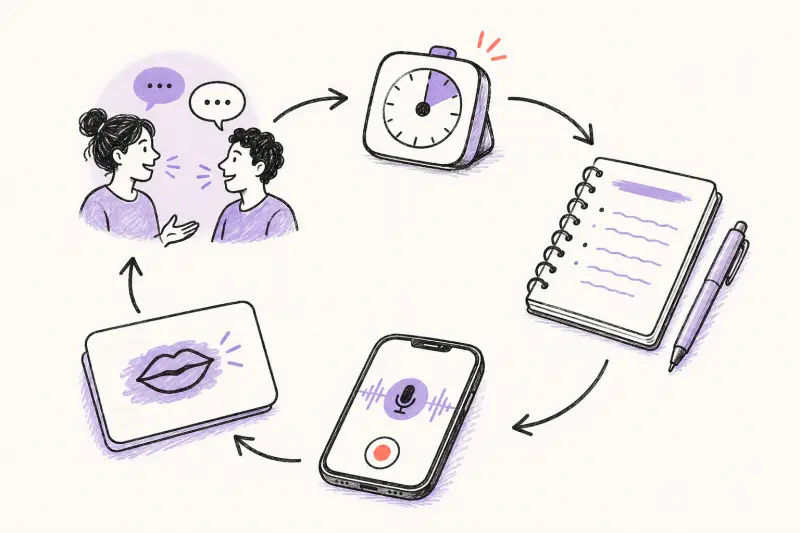
| Time | Practice | What to check |
|---|---|---|
| 2 minutes | Listen to the word and mark the sound or stress you are changing | You can describe the problem in one sentence |
| 3 minutes | Record the word alone and in one short sentence | The key sound stays audible in both versions |
| 3 minutes | Send the audio without the written sentence | Your partner identifies the intended word |
| 2 minutes | Apply one correction and record again | The second recording needs less explanation or repetition |
After your partner helps with one English sound, offer to check a word in the language they are learning. This keeps the exchange useful for both of you. For a broader self-check before or after the exchange, use this pronunciation practice routine to compare your recording with a model and listener response.
FAQ
What are the most common English pronunciation mistakes?
The most common problems include confusing similar vowels, replacing unfamiliar consonants, dropping final sounds, stressing the wrong syllable, and speaking connected phrases with the wrong rhythm. Start with the mistake that causes people to misunderstand a word you actually use.
How can I improve my English pronunciation quickly?
Choose one word, listen to a reliable recording, practice it in a short sentence, and ask another person to identify it without seeing the text. Repeating this small cycle is more useful than trying to fix your entire accent in one session.
How do I know whether my pronunciation is understandable?
Record the word or sentence without subtitles or spelling and ask a listener to repeat the word they heard. If they identify it correctly without extra clues, your pronunciation is working in that context. If not, ask them to name one sound that was unclear.
Should I focus on sounds, word stress, or speaking speed first?
Start with the issue that changes the word or causes the most repetition. A missing final sound or wrong vowel may come first; if the word is clear alone but not in a sentence, check stress and speed next.
Choose one word that was misunderstood this week, record it once, and ask a partner what they hear before you send the spelling.