Why Understanding English Doesn't Mean You're Ready for University
For a lot of people, studying abroad feels like the finish line of years spent learning English.
You pass the required exams. You can follow YouTube videos without subtitles. You chat comfortably with native speakers. By the time university starts, it feels like the hard part should be over. Then the first lecture begins.
A professor walks through fifty slides in an hour. New terminology appears every few minutes. References are made to papers you've never heard of. Halfway through the class, you're still trying to write down a point from ten minutes ago. It's a surprisingly common experience.
Everyday English and Academic English Are Different Things
Most language learners spend years preparing for real-world communication.
You learn how to introduce yourself, ask questions, express opinions, and navigate everyday situations. These skills matter, and they're often what help students settle into life abroad.
University classrooms, however, operate differently. Lectures are designed to deliver information efficiently, not necessarily slowly. Professors assume students will continue exploring the material after class through readings, assignments, and discussion sessions. As a result, understanding every sentence is often less important than understanding the overall structure of an idea.
The Challenge Isn't Always Language
Many students eventually realize that their biggest problem isn't English. It's information overload.
A single course might include lecture recordings, slide decks, PDF readings, discussion notes, assignment guidelines, and exam materials. Important concepts are spread across different formats and collected over several months.
Trying to organize all of that information can become more difficult than understanding the language itself.
Why Some Students Adapt Faster
Students who thrive academically aren't always the ones with the highest language scores.
Often, they're the students who build systems. Some students build these systems manually, while others use tools like Capsu to organize lecture recordings, notes, and course materials in one place. They develop ways to capture information, review it regularly, and connect concepts across different classes. Their notes are easier to revisit. Their revision process is less stressful. By the time exams arrive, they're not starting from scratch.
The difference is rarely talent. More often, it's workflow.
The Rise of Academic AI Tools
This shift has also changed the way students use technology.
Language-learning tools remain valuable for improving communication skills, but a growing number of students are now looking for tools that help with the academic side of university life.
Platforms such as Capsu are designed for students who spend hours every week moving between lectures, readings, assignments, and exam preparation. By recording lectures in real time and turning course materials into structured study resources, these tools help students spend less time organizing information and more time learning from it.
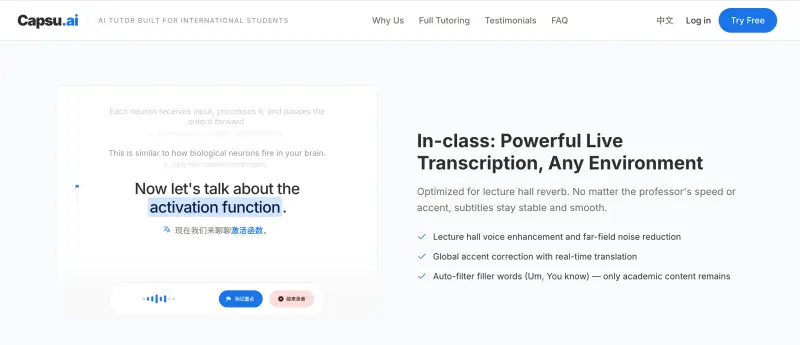 When exam season arrives, having searchable notes, review guides, and practice materials often matters more than trying to remember where a particular concept was mentioned weeks earlier.
That distinction matters because most university challenges don't come from a lack of effort. They come from having too much information to manage.
Learning English Opens the Door
Studying abroad requires language skills, but succeeding at university requires something more.
At some point, students move beyond learning English and begin learning how to learn in English.
For many, that's the transition nobody talks about before the first semester begins.