
The Hidden Challenge International Students Face After Improving Their English
Before studying abroad, most students assume that English is the biggest obstacle standing in their way. That assumption makes sense. Language exams, vocabulary lists, speaking practice, and listening exercises often dominate the entire preparation process. Many students spend years working toward the moment they finally feel comfortable using English in everyday life.
Then university begins. Surprisingly, that's when a different challenge starts to emerge.
When Language Stops Being the Main Problem
One of the most common experiences among international students is realizing that understanding English doesn't automatically make studying easier.
You may be able to follow conversations with classmates. Ordering food, joining clubs, and navigating daily life suddenly feel manageable. But lectures, readings, assignments, and exams can still feel overwhelming. The issue isn't necessarily language anymore. It's the volume of information.
University Learning Works Differently
Unlike language classes, university courses rarely focus on one skill at a time.
A single week might include:
-
Multiple lectures
-
Hundreds of pages of reading
-
Group discussions
-
Assignment deadlines
-
Quiz or exam preparation
Important information appears everywhere. A concept mentioned briefly in a lecture may reappear in a reading, become part of a seminar discussion, and later show up on an exam.
Keeping track of these connections is often harder than understanding the English itself.
The Students Who Adapt Fastest Build Systems
Some students seem to settle into university life much faster than others. In many cases, it isn't because they're smarter or more fluent. They simply develop systems for organizing information.
Their notes are easier to revisit. Their course materials are easier to find. They spend less time searching through files and more time reviewing concepts. Some students build these systems manually, while others use tools like Capsu to keep lecture recordings, notes, PDFs, and study materials organized throughout the semester.
Information Overload Becomes an Academic Skill
One thing that often surprises first-year students is that organization itself becomes an academic skill. Success isn't just about attending lectures. It's about knowing where your information is, understanding what matters most, and having a process for reviewing it later.
Students who consistently review material throughout the semester often experience less stress when exams arrive because they're not trying to reconstruct months of learning at the last minute.
Why Study Tools Are Becoming More Popular
As university workloads become increasingly digital, students are looking for ways to manage information more efficiently. Lecture recordings, PDFs, slide decks, discussion notes, and assignment feedback can quickly become difficult to manage across multiple courses.
This is one reason why AI-powered study tools have become increasingly popular among students. By helping organize course materials and generate structured review resources, these tools allow students to spend less time searching for information and more time preparing for discussions, assignments, and exams.
For many students, the biggest benefit appears later in the semester when revision becomes faster because important concepts are already organized and easier to revisit. That distinction matters because most university challenges don't come from a lack of effort. They come from having too much information to manage.
The Challenge Nobody Talks About
Language learning is often presented as the key to studying abroad. In reality, it's only the beginning.
Once classes start, students face a second challenge: learning how to manage information, connect ideas, and build effective study habits in a completely new academic environment. That's the part many people don't expect. And it's often the skill that makes the biggest difference by the end of the semester.
A Smarter Way to Stay on Top of Coursework
University success depends on more than understanding English. Students also need effective ways to organize materials, review key concepts, prepare for seminar discussions, and get ready for exams throughout the semester.
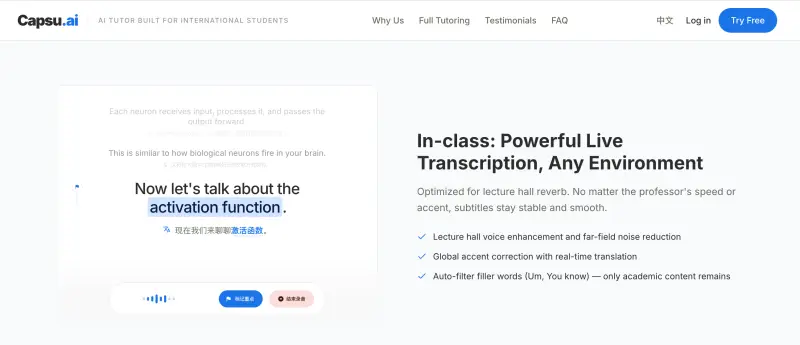
Tools like Capsu help students record lectures, organize study materials, generate review resources, prepare discussion points, and build more effective exam-preparation workflows. For many international students, building a sustainable study system becomes just as important as improving their English.
Frequently Asked Questions
Why do university lectures feel harder than everyday English?
Everyday conversations usually focus on familiar topics and predictable vocabulary. University lectures often introduce complex terminology, abstract concepts, and large amounts of information in a short period of time, making them much more demanding.
Is academic success mainly about English ability?
Not always. Strong English skills help, but organization, note-taking, revision habits, and understanding course expectations often play an equally important role.
What's the biggest challenge after improving your English?
Many students discover that managing information becomes harder than understanding English. Lectures, readings, assignments, discussion notes, and exam materials can quickly become overwhelming without an effective study system.
How do students prepare for seminar discussions?
Preparation usually involves reviewing lecture content, identifying key arguments, and thinking about possible discussion questions in advance. Some students also use tools like Capsu to generate study guides and discussion prompts based on their course materials.
Can AI tools help with exam preparation?
Many students use AI tools to organize notes, create review guides, generate practice questions, and identify important concepts before exams. Tools such as Capsu help students turn lecture recordings and course materials into structured revision resources.
Are AI study tools replacing traditional studying?
No. Most students use them to reduce time spent organizing information. The actual learning still comes from reviewing concepts, participating in discussions, completing assignments, and applying knowledge during exams.