How to Learn Italian Quickly: What Works and What Slows You Down

Most of us don't want to learn Italian "someday." We want to hold a real conversation in Rome this year, or read a menu without panic, or talk to family before the next trip. So the honest question is not "can I learn Italian" but "what actually makes it go faster, and what quietly eats my time?"
We've spent enough time in the messy middle of this to answer that clearly. This is the hub of a small set of guides we've written on speed: if you want the deep dives, we link to them as we go. Here we cover the whole picture at once.
The single biggest speed factor in Italian is how many hours you spend producing the language out loud, not how many hours you spend consuming lessons. Everything below sorts into "this speeds you up" or "this feels productive but slows you down."
Start from the truth: Italian is one of the fastest languages for English speakers
Good news first. The US Foreign Service Institute puts Italian in its easiest tier of languages for English speakers, estimating roughly 24 to 30 weeks of intensive study (about 600 to 750 class hours) to reach professional working proficiency. That is the same category as Spanish and French, and far below the 2,200 hours it estimates for something like Japanese or Arabic.
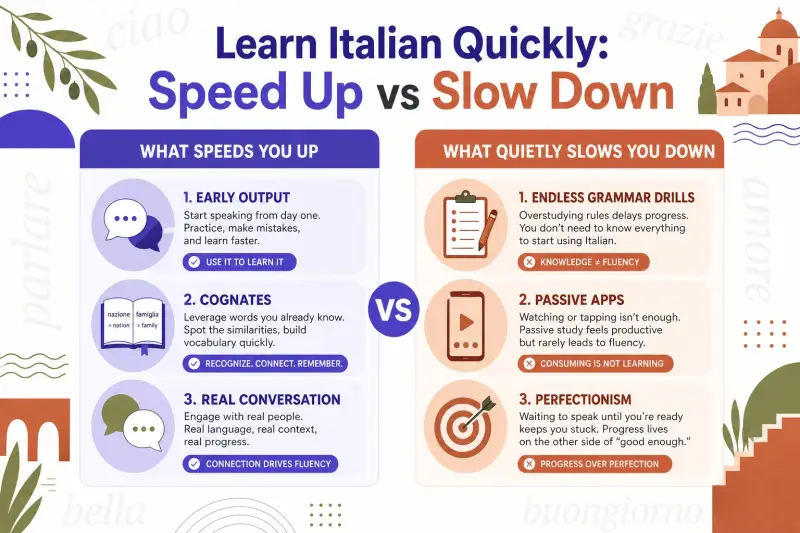
Part of the reason is vocabulary. Nearly 60% of English words have Latin origins, and Italian sits directly on top of Latin, so a huge chunk of Italian vocabulary is already half-familiar. Words like importante, nazione, possibile, and famiglia need almost no memorizing. You start with a running head start most learners never notice.
Because Italian shares so much vocabulary and a mostly phonetic spelling system with English, the early speaking barrier is lower than in almost any other language, which is exactly why speaking early pays off so fast.
What actually speeds you up
Here is the short version of what moves the needle, ranked by impact per hour.
| What you do | Why it speeds you up | How soon it pays off |
|---|---|---|
| Speaking out loud daily with feedback | Forces recall and fixes errors before they set | Days to weeks |
| Learning the 1,000 most common words first | Covers roughly 80% of everyday speech | 2-4 weeks |
| Studying full phrases, not single words | You speak in ready blocks, not translations | Immediately |
| Consistent short sessions (20-30 min) | Beats long weekend cramming for retention | 3-4 weeks |
| Getting corrected by native speakers | Stops fossilized mistakes early | Ongoing |
The through-line is feedback and output. You can memorize a thousand flashcards and still freeze in a real conversation, because reading a word and producing it under pressure are different skills. We go deeper on how to build a real speaking-first routine in our honest look at whether 3 months is enough, and on the exact tools to use in our fastest Italian learning stack for 2026.
What quietly slows you down
This is the part most guides skip. These habits feel like studying, so they're hard to give up.
-
Grammar-first study. Spending week one on verb conjugation tables before you've said a full sentence out loud. You need enough grammar to be understood, not a grammarian's map.
-
Passive input only. Watching Italian shows with subtitles for hours feels immersive, but without production you build recognition, not the ability to speak. Input matters, yet it works best paired with output. We unpack that balance in immersion versus spaced repetition as methods.
-
App streak addiction. Keeping a 300-day streak while never speaking to a human. The streak measures habit, not conversation ability.
-
Perfectionism. Waiting until you "feel ready" to talk. You never feel ready. The people who speak fastest are the ones who speak badly first.
The fastest learners are not the ones who make the fewest mistakes; they are the ones who make their mistakes out loud, early, in front of someone who can correct them.
The method that ties it together: talk to real people from day one
You can build the input side yourself with courses and shows. The hard part to fake alone is real, interactive output with correction. This is where a language exchange changes the math, because you get native Italian speakers who correct you in exchange for you helping them with English.
On HelloTalk, that exchange runs through four modules that each remove a different point of friction:
-
Chat-based learning. You message native Italian speakers with translation, transcription, read-aloud, and real-time grammar correction built into the chat, so you never leave the app to look something up.
-
Moments. You post a sentence or a photo caption in Italian to the community and get corrections from several native speakers at once, which is faster feedback than any single tutor.
-
Voicerooms and Livestreams. You can drop into a live Italian voice room as a listener first, then start talking when you're ready, which lowers the terror of your first spoken words.
-
AI learning tools. AI pronunciation scoring points at the exact sound you're missing, and AI grammar correction explains the fix in real time, so you improve between conversations too.
HelloTalk has more than 70M registered users across 200+ countries and 260+ languages, with 90% of core features free, so finding Italian speakers to practice with daily costs nothing. It's the difference between practicing Italian and practicing talking about Italian.
A language exchange speeds you up because it turns study time into conversation time, and conversation time is the one input the FSI hours are really counting.
For a structured comparison of doing this through a course, a class, or an exchange, see Italian online courses versus language exchange, and for the bigger picture read our pillar guide to language exchange.
A realistic fast-track week
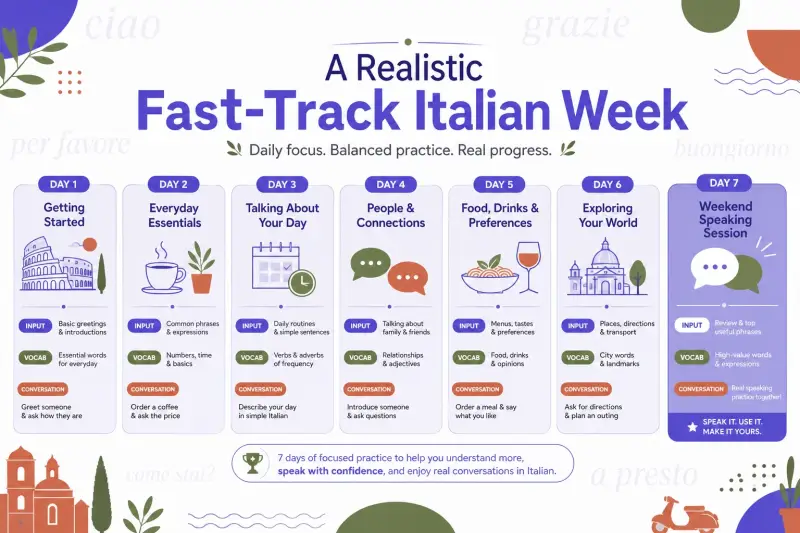
If you want a concrete shape, here's a week that follows the rules above.
| Day | Core action | Time |
|---|---|---|
| Mon-Fri | 20 min core vocab and phrases, 15 min speaking with a partner | 35 min |
| Sat | One longer voice room or live conversation | 45 min |
| Sun | Review corrections you got all week, post one Moment | 30 min |
That's under four hours a week, and it front-loads the two things that matter most: high-frequency vocabulary and daily output.
Common mistakes that cost weeks
-
Buying five apps and finishing none. Pick a lean setup instead, which we lay out in our Italian learning stack.
-
Choosing intensive classes when self-study fits your life better, or the reverse. We compare both in intensive Italian versus self-study.
-
Ignoring pronunciation early, then having to unlearn habits. Italian is largely phonetic, so a little pronunciation work now saves months.
-
Skipping the basics if you're a true beginner. If that's you, start with the best way to learn Italian in 2026 or learning Italian online as a beginner, then come back here for the speed layer.
This Italian speed cluster splits one question into four angles: what actually speeds Italian up, intensive study versus self-study, what three months can realistically cover, and a high-impact tool stack. Speaking partners still sit outside any stack, so keep a path like the language exchange guide open early.
Frequently Asked Questions
How quickly can I learn Italian if I study every day? With focused daily practice, most learners reach a conversational A2 level in about 3 to 6 months. Reaching professional working proficiency takes closer to the FSI estimate of 600 to 750 hours, though you can hold real conversations long before that.
Is Italian actually easy to learn quickly? For English speakers, yes, relatively. Italian is in the FSI's easiest category, shares a large Latin-based vocabulary with English, and has mostly phonetic spelling, so early speaking comes faster than in most languages.
What slows down Italian learners the most? Studying grammar and flashcards without ever speaking. Recognition and production are different skills, so passive-only study builds a false sense of progress that collapses in real conversation.
How many words do I need to speak everyday Italian? Around 1,000 high-frequency words cover roughly 80% of daily conversation. Learning those first, as full phrases, gives you the fastest usable return.
Do I need a tutor to learn Italian fast? Not necessarily. A tutor helps, but daily correction from native speakers through a free language exchange covers most of the same feedback for far less money.
Can I learn Italian quickly without living in Italy? Yes. Digital immersion through chat, voice rooms, and community posts with native speakers gives you real interaction from home, which is the ingredient that used to require moving abroad.
Speed Comes From Early Output
The fastest path is the least glamorous one: speak a little Italian, out loud, every day, and let native speakers correct you. Pick your high-frequency words, keep sessions short, and get talking before you feel ready.
You can start that today for free. Download HelloTalk at hellotalk.com, find your first Italian speaker, and send one sentence. That single message is the real beginning of speaking Italian quickly.